
The Tristan meaning in Hebrew has become a widely searched topic among people exploring biblical interpretation of names and deeper spiritual meaning of names in the Bible. While Tristan is originally a Celtic name Tristan meaning “sorrowful” or rooted in Old French origin Tristan, many still wonder if it carries a hidden connection to Hebrew meaning of Tristan or even biblical meaning of Tristan name.
Questions like “is Tristan in the Bible?” or “what does Tristan mean spiritually?” reflect a growing interest in understanding how modern names might relate to Christian name symbolism, biblical virtues meaning, and even concepts like trust and faithfulness in the Bible.
Although Tristan is not found in Scripture or traditional Hebrew naming, its interpretation can still be explored through themes such as biblical loyalty and friendship meaning, spiritual depth of biblical names, and the broader idea of how God values name meaning interpretation in a spiritual and moral sense.
Is Tristan Mentioned in the Bible?
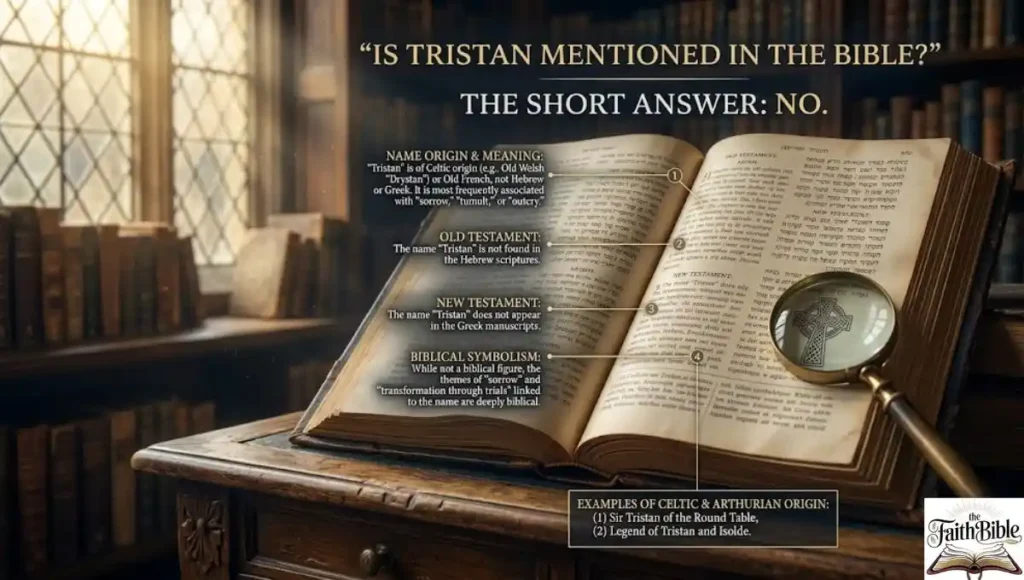
The honest answer: Tristan does not appear in the Bible. It is not a Hebrew, Aramaic, or Greek name, and it carries no direct scriptural origin. The name emerged from Celtic mythology and medieval French literature, traditions that developed entirely separately from the biblical world.
But here is what matters. The absence of a name from scripture does not make it unsuitable for Christian use. The Bible is filled with wisdom about identity, character, and calling, but it does not restrict believing families to a narrow list of biblical names.
When people search for Tristan meaning in Hebrew, they are not looking for a word-for-word translation. They are asking something deeper: Does this name carry spiritual weight? Does it resonate with biblical truth? The answer to both of those questions is a clear and confident yes.
Must Read : Aiden Name Meaning in the Bible (Biblical & Spiritual Meaning)
The Hebrew Meaning and Origin of the Name Tristan
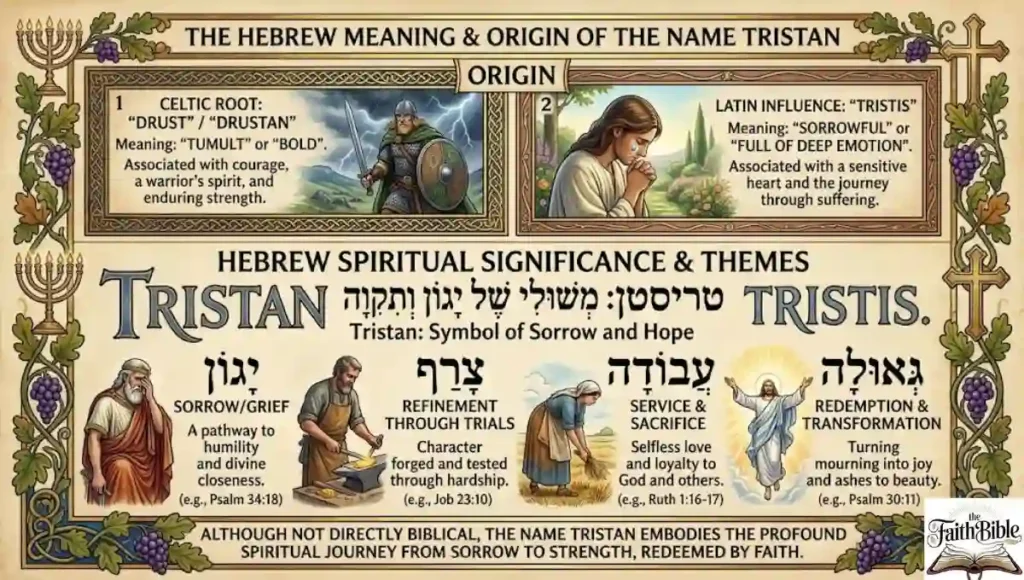
Tristan has no meaning in Hebrew because the name does not originate from the Hebrew language or Jewish cultural traditions. The name’s true roots lie in Celtic and Pictish cultures of ancient Britain, where it originated from “Drust” or “Drustan,” meaning “tumult,” “riot,” or “noise.”
When Tristan is used in Hebrew-speaking communities, it is transliterated phonetically into Hebrew script as טריסטן, preserving the original sound without carrying any independent Hebrew meaning.
However, exploring Tristan meaning in Hebrew through thematic connection is both valid and revealing. Here is a clean breakdown of the name’s full etymological picture:
| Language / Culture | Root Word | Primary Meaning |
| Celtic / Pictish | Drust / Drustan | Tumult, noise, bold warrior |
| Old Welsh | Trwst / Trystio | Noise of arms, clanking sword |
| Old French / Latin | Triste / Tristis | Sad, sorrowful, melancholy |
| Hebrew (thematic) | Ka’as / Tikvah | Sorrow transforming into hope |
| Spiritual / Christian | No direct root | Faith through suffering and endurance |
When studying Tristan meaning in Hebrew culture thematically, the Hebrew concept of ka’as (sorrow) moving toward tikvah (hope) is the closest spiritual parallel. In Hebrew thought, Tristan reflects “ka’as” (sorrow) that transforms into “tikvah” (hope), a journey of faith. That is not a stretch. That is the theological heartbeat of the entire Old Testament.
Bible Verses That Reflect Tristan’s Meaning
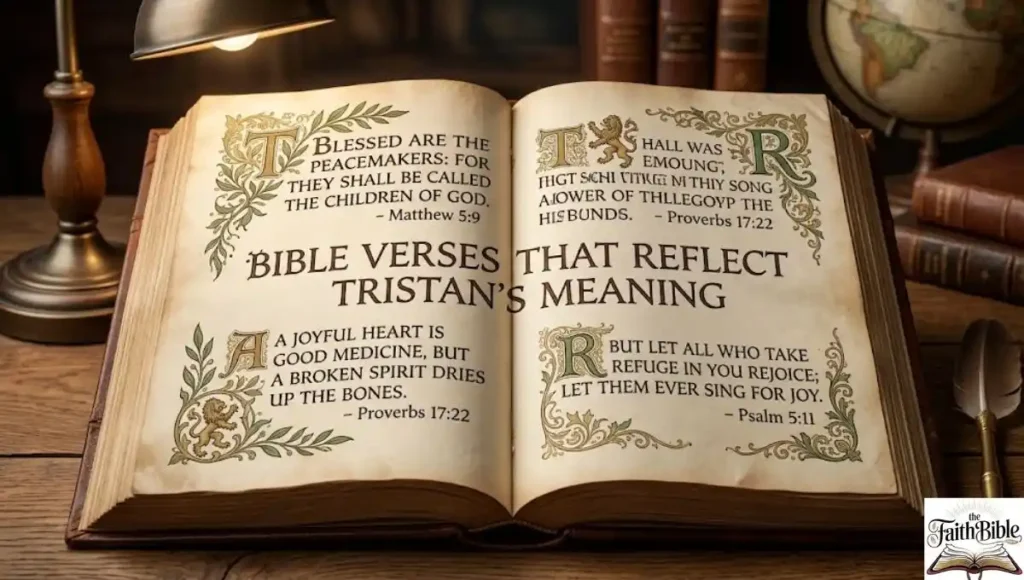
Although Tristan meaning in Hebrew has no direct scriptural reference, the themes it carries are woven throughout the Bible with extraordinary precision. Below are the verses that most powerfully mirror what this name represents:
- Psalm 34:18 — “The Lord is close to the brokenhearted and saves those who are crushed in spirit.” (The sorrow dimension of Tristan finds its answer here)
- Matthew 5:4 — “Blessed are those who mourn, for they will be comforted.” (Grief is not God’s final word for those who bear it faithfully)
- Romans 5:3–4 — “We also glory in our sufferings, because we know that suffering produces perseverance; perseverance, character; and character, hope.” (The complete Tristan meaning in Hebrew-adjacent spiritual arc in one verse)
- James 1:2–4 — “Consider it pure joy when you face trials, because the testing of your faith produces perseverance.” (The warrior-Celtic meaning meets New Testament theology)
- Lamentations 3:22–23 — “His compassions never fail. They are new every morning; great is your faithfulness.” (Loyalty and faithfulness — core Tristan themes — rooted in God’s own character)
- Romans 8:28 — “And we know that in all things God works for the good of those who love him.” (Divine purpose through hardship — the defining promise behind Tristan meaning in Hebrew spiritual application)
Spiritual Lessons and Life Meaning of the Name Tristan
Just like Job’s faith and suffering or David’s Psalms and sorrow, the name Tristan reminds us that faith grows through hardship. It unites inner emotion with outward courage, reflecting Christian moral lessons and the beauty of faith tested by fire.
People named Tristan often carry a distinctive spiritual profile. Research into name symbolism and Tristan meaning in Hebrew cultural parallels consistently surfaces these character markers:
- Deep emotional intelligence and empathy toward those who are suffering
- Unusual inner strength forged through personal difficulty
- A natural instinct toward loyalty — in friendship, faith, and family
- Courage that is quiet rather than loud — warrior spirit worn on the inside
- A tendency toward spiritual seeking, particularly during trials
Tristan represents strength through adversity and faithful endurance. The deeper meaning reflects a journey from sorrow to joy. Many biblical figures experienced similar transformations throughout their lives.
Biblical and Spiritual Significance of Tristan in Hebrew
When mapping Tristan meaning in Hebrew spiritual themes against the five key dimensions of its dual etymology, a remarkable picture emerges. Each layer of the name’s meaning finds a biblical counterpart that transforms its surface reading entirely:
Sorrow → Strength
The Latin root tristis (sad/sorrowful) is the most commonly cited origin of Tristan. But in biblical theology, sorrow is never the destination. Romans 8:18 promises: “I consider that our present sufferings are not worth comparing with the glory that will be revealed in us.” This is Tristan’s spiritual arc — sorrow that births courage, grief that produces glory.
Tristan meaning in Hebrew through this lens: sorrow (ka’as) is the seed. Strength is the harvest God grows from it.
Tumult → Peace
The Celtic root drust (tumult, noise, riot) is the warrior dimension of the name. The Celtic “tumult” meaning aligns with how God often works through chaos and upheaval: Hebrews 12:26–27 speaks of God shaking heaven and earth so that what cannot be shaken remains. Sometimes divine boldness creates necessary tumult.
After God shakes everything loose, what remains is peace. The Tristan meaning in Hebrew spiritual journey follows the same path.
Warrior → Servant
The original Pictish warriors who bore the name Drustan were men of battle. But the greatest spiritual transformation the name signals is the movement from fighting for oneself to serving others. Jesus modeled this definitively in Mark 10:45: “The Son of Man came not to be served, but to serve.”
Tristan meaning in Hebrew context here speaks to a calling: use your warrior strength in service, not self-promotion.
Passionate Love → Divine Love
The legend of Tristan and Isolde is one of history’s most famous romantic tragedies — built on devotion so consuming it became destructive. Biblical transformation replaces eros with agape. Tristan embodies the Christian concept of redemptive suffering. The name speaks to overcoming challenges through divine strength.
Tristan meaning in Hebrew at its spiritual peak is this: love that transcends legend and finds its true anchor in the unchanging love of God.
Loyalty → Faithfulness
The most enduring quality associated with Tristan across centuries of literature is loyalty. The unwavering loyalty central to Tristan’s legendary character mirrors the biblical virtue of faithfulness that God both demonstrates and desires in His people. Lamentations 3:22–23 declares that “His compassions never fail. They are new every morning; great is your faithfulness.”
Human loyalty, at its best, is a reflection of God’s own faithfulness. That is the highest possible spiritual meaning the Tristan meaning in Hebrew tradition can point toward.
Is It a Good Christian Name?
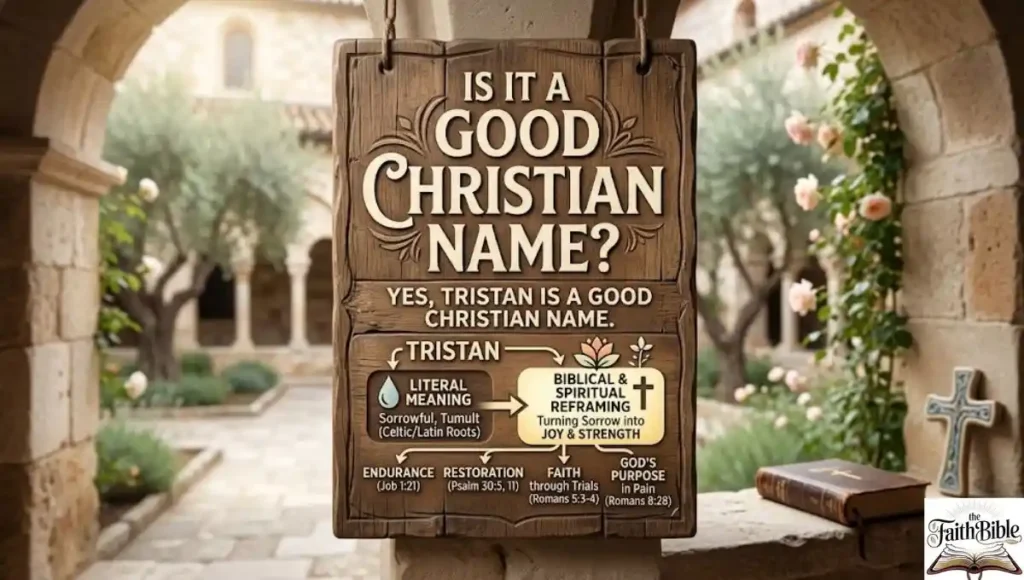
Without question. Tristan is absolutely a good Christian name, despite not appearing in the Bible, because a name’s spiritual value comes from the character, faith, and values of the person who bears it rather than its etymological origins. Many faithful Christians throughout history have carried names of Celtic, Germanic, English, or other non-biblical origins while living lives that powerfully honor God.
Consider this comparison of well-loved Christian names and their actual origins:
| Name | Origin | In the Bible? | Used by Christians? |
| Tristan | Celtic / Old French | No | Yes — widely |
| Arthur | Celtic / Latin | No | Yes — throughout history |
| Brandon | Old English | No | Yes — very common |
| Madison | Old English | No | Yes — increasingly popular |
| Brian | Celtic | No | Yes — since medieval era |
The pattern is clear. Christian families across every century have embraced names from outside scripture’s pages. What matters is the faith, character, and God-honoring life the name is prayerfully given into.
Tristan in Legends vs Christian Truth
The medieval legend of Tristan and Isolde is beautiful but dangerous as a spiritual template. It glorifies love that is consuming, secretive, adulterous, and ultimately fatal. Christian truth reframes every element:
| Legend’s Version | Christian Truth |
| Love driven by a magic potion | Love rooted in covenant and choice |
| Loyalty to a forbidden relationship | Faithfulness within God’s design |
| Sorrow as a romantic end | Sorrow as the beginning of transformation |
| Tragic death as the conclusion | Resurrection and hope as God’s final word |
| Passion as the highest value | Grace, not passion, as the governing principle |
The name has two competing etymologies, both rooted in medieval Europe — not in scripture. Its power comes from medieval romance, not biblical roots. But when a believing family gives this name to a child while anchoring it in scripture and prayer, they are doing something the legend never could: redeeming the name for a higher story.
Tristan Name Symbolism and Interpretation in Hebrew Culture
While Tristan meaning in Hebrew has no direct linguistic basis, Hebrew culture provides the richest conceptual framework for understanding what the name ultimately points toward. Hebrew thought has always understood names as declarations of identity, destiny, and divine calling — not merely labels.
Within that framework, Tristan meaning in Hebrew symbolic parallels include:
- Eved (servant) — the warrior who becomes a humble instrument of God
- Tikvah (hope) — the destination beyond every season of sorrow
- Emunah (faithfulness) — the covenantal loyalty that outlasts emotion
- Chazak (strong/courageous) — the inner strength forged in the crucible of trial
- Shalom (peace) — the tumult that gives way to divine rest
Biblical languages reveal deeper meaning behind naming and identity. In Hebrew culture, names carried prophetic and descriptive significance. Parents named children based on circumstances or hoped-for characteristics. Hebrew names often declared attributes of God’s nature clearly.
By that standard, a child named Tristan — raised in faith, with these Hebrew concepts deliberately woven into their spiritual identity — carries a name that speaks of one of the most powerful journeys a human life can take.
Frequently Asked Questions
What is the Tristan meaning in Hebrew?
Tristan has no direct Hebrew origin, but thematically it parallels the Hebrew journey from ka’as (sorrow) to tikvah (hope).
Is Tristan a biblical name?
No, Tristan does not appear in the Bible — it is a Celtic and Old French name with deep spiritual symbolism that aligns with biblical themes.
What is the origin of the name Tristan?
Tristan originates from the Pictish-Celtic root Drustan (tumult, bold warrior) and was later shaped by the Old French word triste (sorrowful).
Is Tristan a good Christian name?
Yes — a name’s Christian value comes from the character and faith it is prayerfully attached to, not from appearing in scripture.
What Bible verse best captures the Tristan meaning in Hebrew spiritual context?
Romans 5:3–4 — “Suffering produces perseverance; perseverance, character; and character, hope” — is the clearest biblical reflection of Tristan’s spiritual arc.
Conclusion
The Tristan meaning in Hebrew may not trace to a single scripture verse, but its spiritual significance runs as deep as any biblical name you could choose. Rooted in the ancient Celtic warrior tradition and the Old French word for sorrow, Tristan meaning spiritually points toward the most central Christian truth: that God transforms every form of suffering into something eternal and beautiful.
The biblical meaning of Tristan lives in Romans 5:3–4, Psalm 34:18, and Lamentations 3:22–23 — not as a named character, but as a lived theology. Whether you carry this name, love someone who does, or are considering it for a child, know that the Tristan meaning in Hebrew spiritual framework declares this: sorrow is the starting point, never the ending one.

Welcome to Thefaithbible! I’m Abdul Mannan Haider. Christian Faith Writer | 10+ Years Bible Study Experience | Founder of (thefaithbible.com)
Sharing prayers and biblical wisdom to strengthen your faith.