
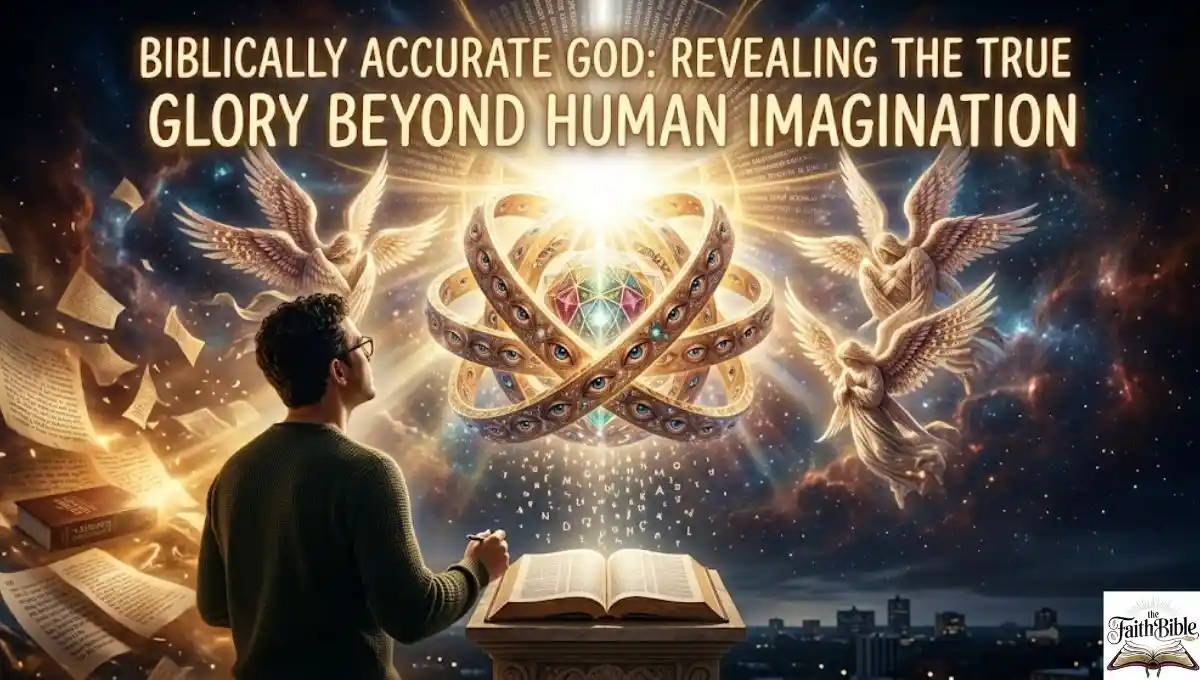
Most people carry a version of God shaped by culture, assumptions, or incomplete teaching—but the biblically accurate God is revealed clearly through Scripture. To understand the nature of God in the Bible, we must move beyond popular belief and explore who God is according to Scripture, where His character, attributes, and divine self-disclosure are consistently revealed from beginning to end.
The true nature of God is not fragmented; it reflects His holiness, sovereignty, justice, mercy, and unchanging love. Through Jesus Christ as the full revelation of God, believers can experience a deeper, personal relationship and truly begin knowing God through Scripture.
This article will guide you toward a biblical view of God, correcting misconceptions, uncovering the attributes of God in Christianity, and showing why understanding God accurately is essential for a transforming faith rooted in truth.
The Concept of a Biblically Accurate God
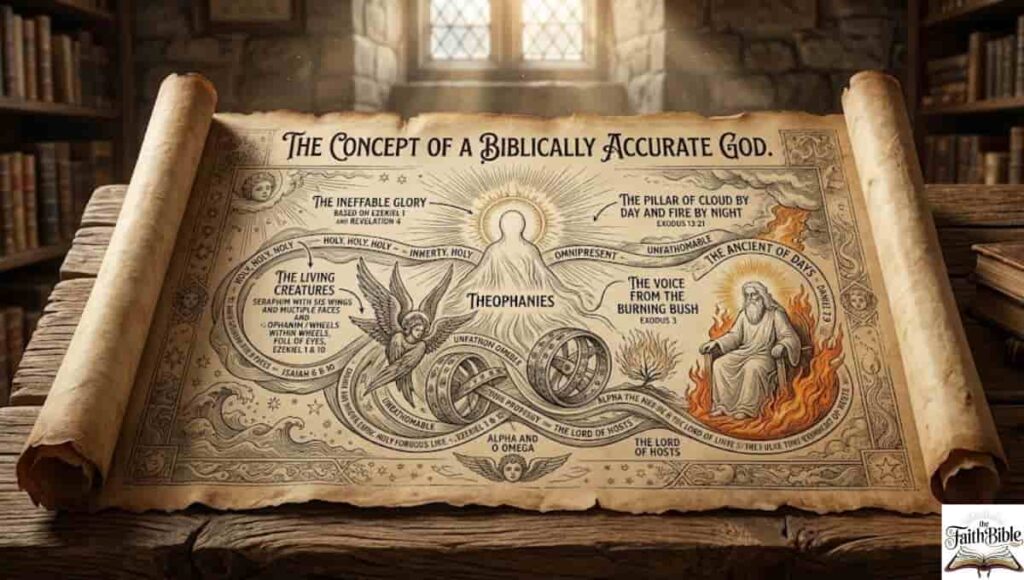
The phrase biblically accurate God means one simple thing: letting Scripture define God rather than letting culture, emotion, or tradition do it. From Genesis 1:1 to Revelation 22:21, God progressively discloses who He is through creation, covenant, law, prophecy, and ultimately through Jesus Christ.
Without this scriptural anchor, people either shrink God into a cosmic vending machine or inflate Him into an impersonal force. Both distortions damage faith. A true nature of God in the Bible understanding demands that we read all of Scripture carefully, let difficult passages stand alongside comforting ones, and trust that God’s character remains perfectly consistent throughout.
“All that we truly know of God comes solely through what He has chosen to reveal about Himself to us through His Word.”
— Blue Letter Bible
See More : Discord Meaning in the Bible: Biblical Symbolism, Spiritual Warning & Hidden Faith Message
Core Divine Attributes Revealed in Scripture
Essential Divine Attributes
The attributes of God in Christianity are not abstract theology — they are revelatory truths that define who God eternally is. Scripture unveils these consistently from cover to cover.
| Attribute | Scripture Reference | Meaning |
| Omnipotence | Job 42:2; Jeremiah 32:17 | All-powerful; nothing thwarts His purpose |
| Omniscience | Isaiah 46:10; Psalm 147:5 | Knows the end from the beginning |
| Omnipresence | Psalm 139:7–10; Jeremiah 23:24 | Present everywhere simultaneously |
| Holiness | Isaiah 6:3; 1 Peter 1:15–16 | Morally perfect; set apart from all sin |
| Love | 1 John 4:8; John 3:16 | Volitional, sacrificial, eternal love |
| Justice | Psalm 89:14; Deuteronomy 32:4 | Perfectly fair; no favoritism |
| Immutability | Malachi 3:6; Numbers 23:19 | Never changes in character or purpose |
| Eternality | Psalm 90:2; Revelation 1:8 | No beginning, no end |
God’s Various Forms and Manifestations
Throughout Scripture, God reveals Himself in ways human beings can actually grasp — what theologians call theophanies. These are not the fullness of God’s glory but gracious accommodations to human limitation.
- Burning Bush — God revealed His personal name “I AM” to Moses (Exodus 3:14)
- Pillar of Cloud and Fire — Guided Israel through the wilderness (Exodus 13:21)
- Isaiah’s Throne Room Vision — Seraphim covered their faces crying “Holy, Holy, Holy” (Isaiah 6:1–3)
- Ezekiel’s Chariot Vision — Dazzling, complex imagery pointing to divine transcendence (Ezekiel 1)
- The Incarnation — The supreme manifestation: God in human flesh through Jesus Christ (John 1:14)
Key Distinctions in Divine Manifestation
Understanding God’s glory in Scripture requires separating three categories:
- God’s Essential Nature — Spirit, eternal, invisible (John 4:24; 1 Timothy 1:17)
- God’s Revealed Presence — Theophanies, visions, angelic messengers
- God’s Incarnate Form — Jesus Christ, the permanent, bodily revelation (Hebrews 1:3)
Biblical Descriptions of God’s Appearance

Prophetic Visions of Divine Glory
The biblical description of God in prophetic literature is deliberately overwhelming. No single image captures Him fully — the language is intentionally symbolic and layered.
- Isaiah saw the Lord “high and lifted up” with the train of His robe filling the Temple (Isaiah 6:1)
- Daniel beheld the Ancient of Days with garments white as snow and hair like pure wool (Daniel 7:9)
- Ezekiel described something “like the appearance of fire” surrounded by radiant light “like a rainbow” (Ezekiel 1:27–28)
- John on Patmos saw One whose face shone “like the sun shining in full strength” (Revelation 1:16)
Each description communicates the same truth: God’s glory is beyond human imagination. Human language reaches its limits and turns to analogy.
Progressive Revelation of God’s Character
Stages of Divine Self-Disclosure
The progressive revelation of God follows a clear pattern across Scripture:
- Creation — God reveals Himself as all-powerful Creator and sovereign over all things (Genesis 1–2)
- Covenant with Abraham — God reveals Himself as faithful, promise-keeping, and relational (Genesis 12–17)
- Law at Sinai — God reveals His holiness, justice, and moral character (Exodus 19–20)
- Prophetic Era — God reveals His mercy, long-suffering patience, and redemptive purposes (Isaiah 40–55)
- The Incarnation — God reveals His fullest self through Jesus Christ (John 1:18; Hebrews 1:1–3)
This progression does not mean God changed. It means He strategically disclosed more of Himself at each stage of redemptive history.
Experiencing the Presence of God in Everyday Life
God’s presence and manifestation are not limited to burning bushes and prophetic visions. The biblically accurate God is equally present in the ordinary rhythms of daily life.
- His omnipresence means no one suffers alone, forgotten in some corner of creation (Psalm 139:8)
- His faithfulness means every promise He made holds today exactly as it did the day He spoke it (Lamentations 3:22–23)
- His love is not reactive — it was set on His people before the foundation of the world (Ephesians 1:4)
- His Spirit actively guides, convicts, comforts, and empowers believers moment by moment (Romans 8:14–16)
Experiencing God is not about chasing dramatic encounters. It is about cultivating daily attentiveness to the God who is always already present.
Jesus Christ: The Complete Revelation of God
Christ as the Perfect Image of God
No question matters more when understanding God’s nature than: Who is Jesus? Scripture gives a stunning answer. Jesus is not merely a window into God — He is God made fully visible.
“The Son is the radiance of God’s glory and the exact representation of his being.” — Hebrews 1:3
Jesus as God’s Exact Representation
The Greek word used in Colossians 1:15 — eikon — means exact representation, not a mere resemblance. Jesus does not approximate God; He is God. Everything invisible about the Father becomes visible in the Son.
- John 1:18 — “No one has ever seen God, but the one and only Son… has made him known”
- Colossians 2:9 — “In Christ all the fullness of the Deity lives in bodily form”
- John 14:9 — “Anyone who has seen me has seen the Father”
Divine Attributes Displayed Through Jesus
Christ’s Demonstration of Divine Attributes
| Attribute | How Jesus Demonstrated It |
| Omnipotence | Calmed storms, raised the dead, created food from nothing |
| Holiness | Lived without sin through every human temptation |
| Love | Died voluntarily for enemies, not just friends (Romans 5:8) |
| Justice | Overturned temple corruption; rebuked religious hypocrisy |
| Mercy | Forgave adulterers, tax collectors, and crucifiers |
| Wisdom | Confounded scholars with Scripture they had misread |
Jesus as the Key to Understanding Scripture
Christ as the Interpretive Lens
Jesus declared in Luke 24:27 that “all the Scriptures” pointed to Him. This means Christ is not one character among many — He is the interpretive key to every page.
God’s Redemptive Work Through Christ
Christ’s Redemptive Accomplishments
- Propitiation — Absorbed God’s just wrath against sin (Romans 3:25)
- Reconciliation — Restored the broken relationship between God and humanity (2 Corinthians 5:19)
- Redemption — Purchased freedom from sin’s bondage (Ephesians 1:7)
- Justification — Declared believers righteous before God’s court (Romans 5:1)
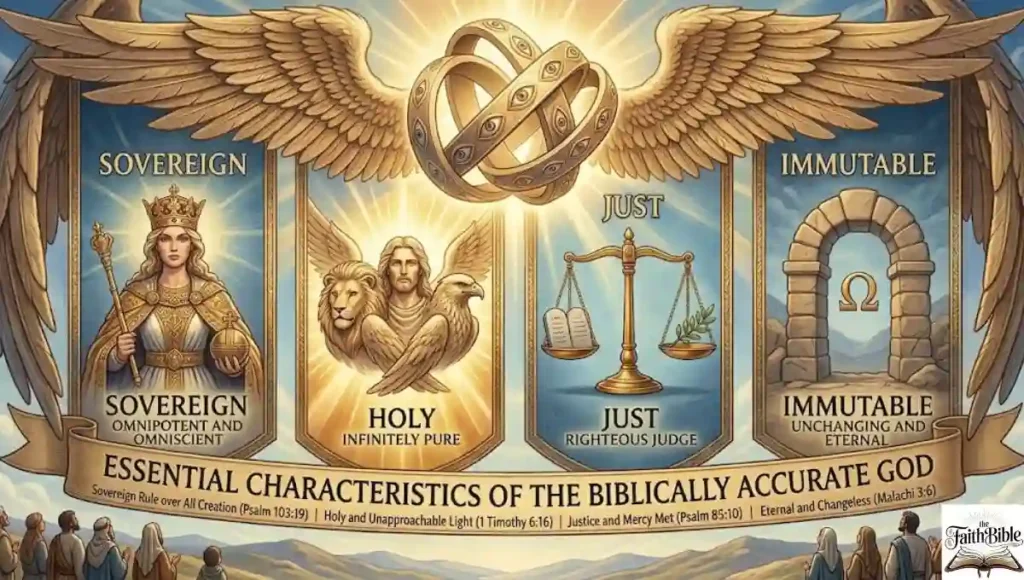
Essential Characteristics of the Biblically Accurate God
Divine Omnipotence and Omniscience
How God’s Power and Knowledge Work Together
God’s omniscience and omnipotence are not competing attributes — they function together in perfect harmony. Because God knows everything (Psalm 147:5), His power is never misdirected. Because He is all-powerful (Jeremiah 32:17), His knowledge is never helpless.
- He knows every outcome before it happens and governs history toward His redemptive purposes
- His power does not override human free will — it works through and around human choices (Acts 2:23)
- He is “able to do immeasurably more than all we ask or imagine” (Ephesians 3:20)
Perfect Holiness and Righteous Justice
The Relationship Between Holiness and Justice
God’s holiness and righteousness are inseparable. Holiness defines what God is — utterly set apart from moral imperfection. Justice defines how God acts — always consistent with that moral perfection.
- Isaiah 6:3 reveals seraphim who never cease declaring His holiness
- Psalm 89:14 declares that “righteousness and justice are the foundation of your throne”
- This combination explains why sin cannot simply be excused — it must be judged and atoned for
Boundless Love and Abundant Mercy
Divine Love and Mercy in Action
God’s love and justice balance finds its ultimate expression at the cross. The same event that demonstrated infinite love also demonstrated perfect justice.
- Love motivated the sacrifice (John 3:16)
- Justice required the sacrifice (Romans 3:25–26)
- Mercy extended the sacrifice to every sinner who believes (Romans 5:8)
This is not contradiction. This is the biblically accurate God in full display.
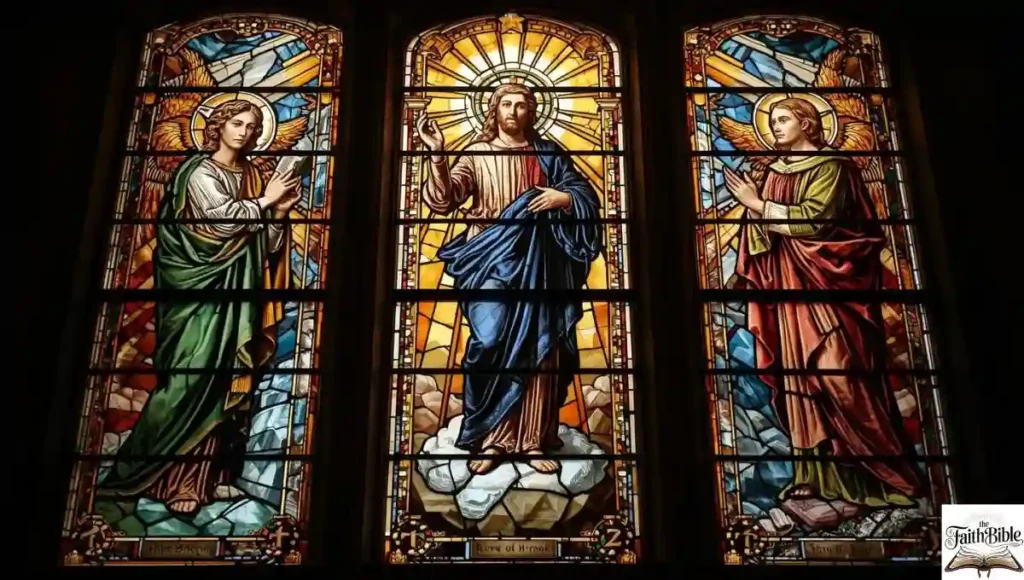
The Triune Nature of God: Father, Son, and Spirit
Biblical Foundation for the Trinity
Scriptural Evidence for Trinitarian Doctrine
The understanding the Trinity Father Son Holy Spirit doctrine emerges from Scripture itself, not from later theological invention.
- Genesis 1:26 — “Let us make mankind in our image” — plural persons within one God
- Deuteronomy 6:4 — “The Lord our God, the Lord is one” — echad in Hebrew allows composite unity
- Matthew 28:19 — One name (singular) for three distinct persons
- 2 Corinthians 13:14 — Grace, love, and fellowship attributed to Son, Father, and Spirit respectively
God the Father’s Role
The Father’s Work in Redemption
- Eternal source and initiator of the plan of salvation (Ephesians 1:3–6)
- Sends the Son and the Spirit (John 3:16; John 14:26)
- Hears and answers the prayers of His children (Matthew 6:9; Romans 8:15)
God the Son’s Work
Christ’s Divine and Mediatorial Functions
- Serves as the one mediator between God and humanity (1 Timothy 2:5)
- Accomplished redemption through His life, death, and resurrection (Hebrews 9:12)
- Intercedes continually for believers at the Father’s right hand (Hebrews 7:25)
God the Holy Spirit’s Ministry
The Spirit’s Multifaceted Work
- Convicts the world of sin, righteousness, and judgment (John 16:8)
- Regenerates and indwells every believer at salvation (John 3:5–6; 1 Corinthians 6:19)
- Guides believers into all truth through illumination of Scripture (John 16:13)
- Empowers witness and service (Acts 1:8)
The Relational Character of God
Implications of God’s Triune Nature
God is not a solitary being who decided to become relational. He has existed in eternal, perfect relationship within Himself — Father, Son, and Spirit in unbroken communion. This means:
- Love is not an attribute God acquired — it is what God has always been (1 John 4:8)
- God created humans not from loneliness but from the overflow of relational love
- Salvation is an invitation into the very relationship shared within the Trinity (John 17:21)
Correcting Common Misconceptions About God
Why Distorted Views of God Develop
Sources of Theological Distortion
Most distorted views of the true nature of God in the Bible trace back to four sources:
- Cultural conditioning — Absorbing society’s therapeutic, consumer-friendly “god”
- Painful experience — Projecting human failures (absent fathers, broken promises) onto God
- Selective reading — Emphasizing favorite verses while ignoring challenging ones
- Inadequate teaching — Churches that prioritize comfort over comprehensive biblical truth
False Images That Misrepresent God
Common Distortions of God’s Character
| Distortion | What It Misses |
| “God is only love” | Ignores His perfect holiness and justice |
| “God is only wrathful” | Ignores His boundless mercy and patience |
| “God is distant and impersonal” | Ignores His omnipresence and covenantal intimacy |
| “God approves of everything I do” | Ignores His moral perfection and call to repentance |
| “Old Testament God vs. New Testament God” | Ignores divine immutability and progressive revelation |
How Scripture Corrects Our Understanding
Process for Correcting Misconceptions
- Identify the specific distortion and name it honestly
- Find Scripture passages that directly address the misrepresentation
- Study those passages in their literary and historical context
- Allow the whole counsel of Scripture to balance the picture
- Submit revised understanding to prayer, community, and ongoing study
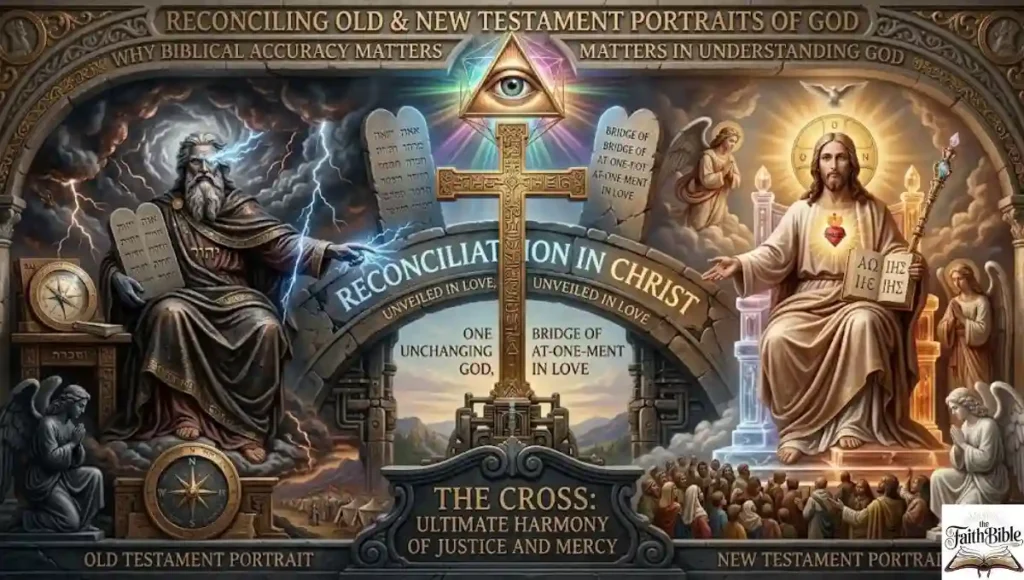
Reconciling Old and New Testament Portraits of God
Progressive Revelation Explained
Understanding Development in Divine Disclosure
One of the most searched questions in Christian theology is: Is God different in Old and New Testament? The answer is a firm no. God does not change (Malachi 3:6). What changes is the depth and clarity of revelation.
The Old Testament is full of shadows, types, and partial disclosures pointing forward. The New Testament reveals their fulfillment. It is not two different Gods — it is one God progressively stepping out of shadow into full light.
God’s Consistent Character Throughout Scripture
Divine Attributes Across Both Testaments
| Attribute | Old Testament | New Testament |
| Holiness | Isaiah 6:3 | 1 Peter 1:15–16 |
| Love | Psalm 103:17 | 1 John 4:8 |
| Justice | Deuteronomy 32:4 | Romans 3:25–26 |
| Mercy | Exodus 34:6–7 | Titus 3:5 |
| Faithfulness | Lamentations 3:22–23 | 2 Timothy 2:13 |
Divine Judgment Across Both Testaments
Continuity of Divine Justice
Contrary to popular assumption, the New Testament contains serious judgments (Acts 5:1–11; Revelation 20:11–15) and the Old Testament contains extraordinary mercy (Psalm 103; Hosea 2:14–23). The God’s covenant relationship with humanity is consistent throughout — holy love always reaching toward sinful humanity.
Christ’s Interpretation of Difficult Passages
Jesus’ Hermeneutical Approach
Jesus modeled how to handle difficult Old Testament passages. In the Sermon on the Mount (Matthew 5–7), He did not abolish challenging texts — He revealed their deeper intention. He showed that the law was always about the heart, not mere external compliance.
Unity of God’s Redemptive Plan
Consistent Redemptive Thread
From Genesis 3:15 — the first messianic promise — to Revelation 22, one unbroken thread of redemption runs through the entire Bible. The God’s plan of salvation never changed direction. Every covenant, every sacrifice, every prophet pointed to the same destination: Jesus Christ, the Lamb of God who takes away the sin of the world.
Common Misinterpretations Regarding God’s Nature
Balancing Divine Love and Justice
How Love and Justice Coexist
Many people set God’s love and justice balance as an either/or choice. Scripture presents them as a both/and reality. God’s love is not soft on sin. His justice is not devoid of compassion.
The cross is the proof: at Calvary, divine love and divine justice did not compromise each other — they fulfilled each other simultaneously. Sin was judged fully. Salvation was offered freely.
Understanding Sovereignty and Human Responsibility
The Paradox of Divine Control and Human Choice
God’s sovereignty and human responsibility are both fully affirmed in Scripture without contradiction. Peter’s Pentecost sermon captures it precisely: Jesus was handed over “by God’s deliberate plan and foreknowledge; and you, with the help of wicked men, put him to death” (Acts 2:23).
God’s control does not eliminate human agency. Human choice does not limit God’s purposes. Both are true. Both matter. Both are honored throughout Scripture.
Why Biblical Accuracy Matters in Understanding God

Knowing God as He Truly Is
Scripture as the Sole Reliable Source
Why accurate theology matters in Christianity is not a question for ivory-tower scholars alone. It is intensely practical. The accurate view of God you hold shapes your prayer life, your emotional responses to suffering, your ethics, your relationships, and your eternal destiny.
- Without scriptural grounding, people worship a god of their own making
- Without God’s holiness, salvation becomes unnecessary
- Without God’s love, relationship becomes impossible
- Without God’s justice, ethics becomes arbitrary
Guiding Faith and Daily Decisions
Practical Impact of Accurate Theology
How to know God according to Scripture is not a purely intellectual exercise. Correct understanding of God directly produces:
- Courage in suffering — because He is sovereign and good
- Generosity — because He is the source of every good gift
- Forgiveness of others — because He has forgiven us so extravagantly
- Honest confession — because His mercy is greater than any sin
Building Authentic Personal Relationship
Intimacy Grounded in Truth
You cannot have genuine intimacy with a god you invented. Real spiritual understanding of God produces real relationship — not religious performance, not emotional manipulation, but the honest, trusting fellowship of a child with a Father who is exactly who He says He is.
Countering False Representations
Correcting Theological Distortions
What most people get wrong about God usually boils down to one error: selecting the attributes they prefer and ignoring the rest. Biblical accuracy demands the whole portrait — majestic and intimate, holy and merciful, sovereign and relational.
Life Transformation Through Knowing God’s True Nature
From Fear to Confident Assurance
Replacing Dread with Bold Access
When people understand the biblically accurate God, dread gives way to confidence. Hebrews 4:16 invites believers to “approach God’s throne of grace with confidence, so that we may receive mercy and find grace.” This boldness is grounded not in our performance but in Christ’s finished work.
From Religious Performance to Grace-Based Rest
Shifting from Striving to Receiving
Accurate theology ends the exhausting cycle of trying to earn God’s favor. The God revealed in the Bible does not demand that His children perform for acceptance — He declares them accepted in Christ and then invites their response of gratitude.
Worship Marked by Reverence and Intimacy
Balanced Worship Characteristics
- Reverence — He is the Holy One before whom seraphim cover their faces
- Intimacy — He is the Father who runs toward prodigal children
- Gratitude — He is the Savior who paid what we owed but could not pay
- Joy — He is the God in whose presence is “fullness of joy” (Psalm 16:11)
Prayer Grounded in Trust
Confidence in God’s Character
Prayer and trust in God deepen when theology is accurate. You pray differently when you know:
- God is good — not withholding anything truly needed
- God is wise — not making mistakes in His timing
- God is powerful — not unable to intervene
- God is faithful — not forgetting His promises
Living with Divine Purpose and Hope
Transformational Outcomes
Knowing the biblically accurate God produces:
- Identity rooted in being God’s beloved child, not performance metrics
- Purpose grounded in His redemptive mission, not personal ambition
- Hope anchored in His promises, not favorable circumstances
- Peace that surpasses understanding, regardless of external conditions
Practical Steps to Learn About the Biblically Accurate God
Systematic Study of Biblical Texts
Organized Approach to Studying God’s Attributes
How to study God’s character in the Bible effectively requires intentional structure:
- Choose one divine attribute (e.g., holiness, mercy, faithfulness) and trace it through both Testaments
- Use a concordance to find every major passage on that attribute
- Study books like Psalms, Isaiah, John, and Romans — Scripture’s richest theological veins
- Read a trusted systematic theology to see how attributes relate to each other
- Always test secondary sources against the primary text of Scripture
Seeking Divine Guidance Through Prayer
Prayer Practices for Deeper Understanding
- Begin every study session with Psalm 119:18 — “Open my eyes that I may see wonderful things in your law”
- Meditate on specific attributes discovered in reading
- Worship God for characteristics encountered during study
- Request personal transformation through truth encountered (James 1:22)
Community and Fellowship’s Vital Role
Maximizing Communal Learning
Theological isolation breeds error. The Christian doctrine of God was refined, protected, and transmitted through community.
- Sit under expository preaching in a Bible-faithful church
- Join a small group studying Scripture weekly
- Engage older, mature believers whose knowledge of God runs deep through lived experience
- Read historical theology — the church has been studying God for two thousand years
Conclusion
The biblically accurate God is simultaneously more glorious and more accessible than most people imagine — a God whose holiness demands reverence, whose love compels intimacy, and whose justice anchors genuine trust. Understanding God’s nature through Scripture is not an academic exercise but the most practically transformative pursuit available to any human being.
Every distortion of God’s character produces a distorted life; every accurate understanding produces freedom, purpose, and unshakable hope. Begin today: open Scripture, pray for illumination, and let the true nature of God in the Bible reshape everything you believe, how you live, and who you are becoming.
Frequently Asked Questions
What does “biblically accurate God” mean?
It means understanding God exclusively through what Scripture reveals, not through cultural assumptions or personal preferences.
How is God described in the Bible?
God is described as eternal, omnipotent, omniscient, holy, loving, just, and unchanging throughout both the Old and New Testaments.
Is the God of the Old Testament different from the New Testament?
No — God’s character is immutable; only the depth and clarity of His self-revelation increases through progressive disclosure.
How does Jesus reveal the true nature of God?
Jesus is the exact representation of God’s being (Hebrews 1:3) — every divine attribute is fully and visibly expressed through His life, death, and resurrection.
Why does accurate theology about God matter practically?
It directly shapes prayer, ethical choices, emotional resilience in suffering, and the quality of personal relationship with God.
How do I begin building a relationship with God based on biblical accuracy?
Begin by studying Scripture systematically, praying for the Spirit’s illumination, finding a sound teaching community, and allowing what you discover about God’s true character to reshape your prayers, worship, and daily decisions.
What role does the Holy Spirit play in knowing God?
The Holy Spirit helps believers understand Scripture, reveals God’s truth, and enables a deeper personal relationship with Him by dwelling within them.
Why is it important to study the whole Bible to understand God?
Because God reveals Himself progressively throughout all of Scripture, studying the entire Bible provides a fuller, balanced understanding of His character, purposes, and plan.

Welcome to Thefaithbible! I’m Abdul Mannan Haider. Christian Faith Writer | 10+ Years Bible Study Experience | Founder of (thefaithbible.com)
Sharing prayers and biblical wisdom to strengthen your faith.