

The biblical meaning of Charles is a powerful and timeless topic that reflects strength, leadership, and spiritual purpose. Many people wonder, “is Charles a biblical name?” or “what does Charles mean spiritually?”, and while the name Charles meaning in Bible is not directly found in Scripture, its deeper symbolism aligns beautifully with Christian values and faith-based living.
From a Charles name meaning Christian perspective, this name represents qualities of humility, courage, and godly leadership—traits often associated with strong Christian boy names and names that symbolize leadership and strength. Exploring the spiritual meaning of Charles reveals a deeper meaning connected to the significance of names in the Bible, where names reflect God’s purpose, identity, and calling.
As one of the most meaningful and inspiring choices among traditional Christian baby names, Charles carries a divine connection to faith, character, and the journey of living a life rooted in obedience, integrity, and purpose.
Origin and Meaning of Charles
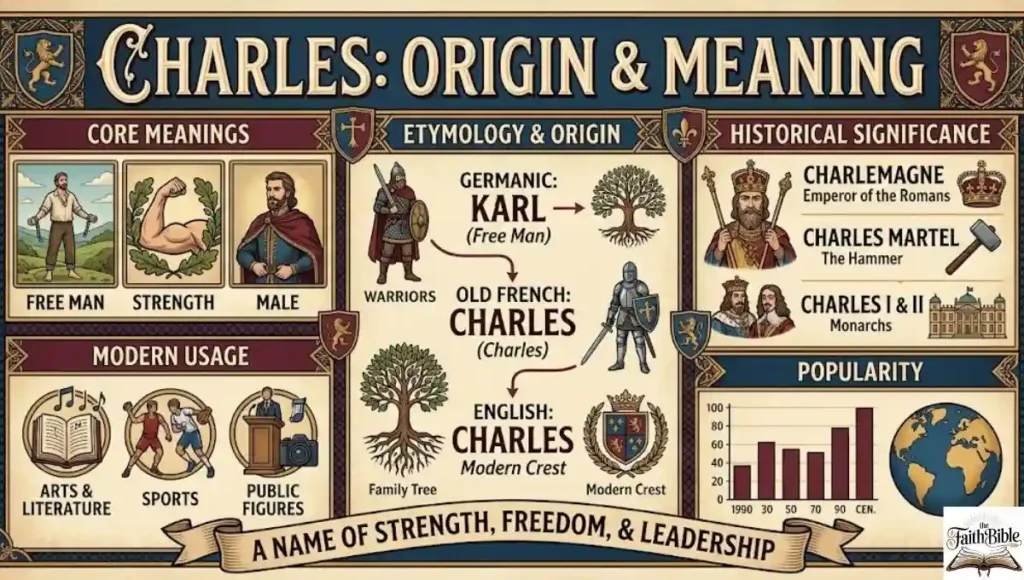
Let us begin with the honest, research-verified truth: the name Charles does not appear in the Bible. It is a Germanic name, not a Hebrew or Greek one, and it did not exist in the ancient Near East. But that is where the straightforward part ends and the fascinating part begins.
The name Charles is derived from the Germanic word karl, meaning “free man” or “strong man.” The name’s etymology is a Common Germanic noun karilaz meaning “free man,” which survives in Old English as ceorl. Historically, a karl occupied a specific social position — not a slave, not a nobleman by birthright, but a free man who owned his land, answered to no master, and earned his place through capability and character. That distinction carries spiritual weight that echoes all the way through the New Testament.
Over centuries, the name Charles journeyed from Germanic tribes to French royalty to the entire Christian world, primarily through one towering figure: Charlemagne — Carolus Magnus, “Charles the Great” — the Frankish emperor who united much of western and central Europe in the early Middle Ages and shaped the Christian West more than almost any ruler in history.
Also Read : The Fascinating Biblical Meaning of the Name HAILEY
Name Charles at a Glance
| Element | Detail |
| Root Name | Germanic Karl / Karilaz |
| Core Meaning | “Free man” / “Strong man” / “Manly” |
| Secondary Meaning | “Warrior” (from hari, army) |
| Latin Form | Carolus |
| Hebrew Equivalent | Chofshi (חָפְשִׁי) — free, liberated |
| Most Famous Bearer | Charlemagne (Charles the Great) |
| Patron Saint | Saint Charles Borromeo (1538–1584) |
| US Popularity Peak | 1947 — over 2.4 million US bearers |
| Modern Standing | Classic “forever name” — timeless in 2026 |
The Charles name meaning is not simply a dictionary entry — it is a social, spiritual, and historical declaration. A free man who leads not by inheritance but by character. A strong man who protects not by force but by faith. This is the foundation on which every biblical parallel rests.
Charles and Biblical Themes

While the name Charles is not in Scripture, its core meanings — freedom, strength, noble character — are woven into the very fabric of the New Testament’s most urgent messages. The biblical meaning of Charles lives in these three powerful themes.
1. Freedom in Christ
The most compelling connection in the Charles meaning Christian tradition is the one between “free man” and the radical freedom that Scripture declares is available to every believer through Jesus Christ.
Galatians 5:1 is the verse that defines this connection most clearly: “It is for freedom that Christ has set us free. Stand firm, then, and do not let yourselves be burdened again by a yoke of slavery.”
This is not political freedom or financial freedom. This is the deepest kind of liberation the human soul can experience — freedom from guilt, shame, condemnation, and the power of sin. The name Charles meaning “free man” aligns directly with what Christ purchased for every believer.
Bible verses that bring the “free man” meaning to life:
- John 8:36 — “So if the Son sets you free, you will be free indeed.”
- Galatians 5:1 — “It is for freedom that Christ has set us free; stand firm.”
- 2 Corinthians 3:17 — “Where the Spirit of the Lord is, there is freedom.”
- 1 Peter 2:16 — “Live as free people, but do not use your freedom as a cover-up for evil.”
- Romans 8:2 — “The law of the Spirit of life has set you free from the law of sin and death.”
The Charles meaning in Christianity therefore carries this profound truth: every person named Charles carries a name that declares, in its very etymology, what the cross of Christ accomplished. They are, by name, the free people God always intended them to be.
2. Strength and Leadership
The second great biblical theme woven into the name Charles is strength — not the raw, aggressive strength of conquest, but the courageous, God-grounded strength that Scripture commands of those He calls to lead.
The Germanic karl also connects to hari, meaning “army” or “warrior.” Combined with the free man meaning, this creates the portrait of someone who leads with both liberty and courage — exactly the kind of leader God spoke to in Joshua 1:9:
“Have I not commanded you? Be strong and courageous. Do not be afraid; do not be discouraged, for the Lord your God will be with you wherever you go.”
The biblical portrait of strength reflected in the name Charles:
- Strength that is commanded, not earned — God tells Joshua to be strong, not to become strong
- Courage that is grounded in God’s presence, not human ability
- Leadership that serves rather than dominates (Mark 10:43–44)
- Spiritual endurance that outlasts physical circumstances (Philippians 4:13)
- Protection of the vulnerable — the natural instinct of the karl, the free man of substance
The what does Charles mean in the Bible answer, through this lens, is a portrait of a godly leader: one who stands firm not in self-confidence but in the unshakeable presence of God.
3. Noble Character
The third biblical dimension of the name Charles is nobility — and not the nobility of bloodline, but the far rarer nobility of character that Scripture celebrates above all human achievements.
Proverbs 20:7 captures it with breathtaking simplicity: “The righteous man walks in his integrity; his children are blessed after him.”
In the ancient Germanic world, a karl was not noble by birth — he was respected by character. He owned his land not because it was given to him but because he earned it. He was free not because a king declared it but because his community recognized his standing. This is precisely what biblical nobility looks like: a life of integrity, consistency, and faithful service that earns the blessing of God and the trust of others.
What noble character looks like for a person named Charles:
- Integrity that does not change based on who is watching (Proverbs 11:3)
- Humility that does not require recognition to keep serving (Micah 6:8)
- Faithfulness in small things that builds a legacy for generations (Luke 16:10)
- Justice and kindness held together in every relationship (Proverbs 21:3)
- A name worth leaving — one that blesses children and children’s children (Proverbs 20:7)
Charles as a Spiritual Reflection

The Charles name meaning spiritual depth goes beyond any single theme. When you hold all three meanings together — free man, strong man, man of noble character — a complete spiritual portrait emerges.
Spiritually, the name Charles reflects a soul that has been liberated by grace, equipped by God’s strength, and called to lead with integrity. It is not a passive name. It is not a name for someone who drifts. It is a name that carries a call — to stand up, to stand firm, and to live in a way that reflects the freedom Christ purchased.
Spiritual qualities embodied in the name Charles:
- Freedom without foolishness — 1 Peter 2:16 reminds that freedom is to be used for service, not self-indulgence
- Strength without arrogance — the greatest leaders in Scripture led with humility, not pride
- Nobility without entitlement — Proverbs 20:7 rewards the righteous man’s integrity, not his status
- Protection of others — the karl used his freedom to shield the vulnerable, echoing Psalm 82:3–4
- Faithfulness as a legacy — a person named Charles is spiritually invited to build something that outlasts them
The Charles name meaning Christianity tradition also draws richly from the legacy of Saint Charles Borromeo — the 16th-century Italian cardinal who became one of the most significant reformers of the Catholic Church, known for his extraordinary compassion for the poor during a plague, his fierce commitment to education, and his personal asceticism. He embodied every quality the name declares: free from worldly corruption, strong in conviction, noble in character.
Historical and Modern Associations

No name in Western history has been worn by more kings, emperors, saints, and leaders than Charles. This is not coincidence — it is the name choosing its people, and its people rising to its meaning.
Notable Bearers of the Name Charles
| Figure | Era | Significance |
| Charlemagne (Charles the Great) | 742–814 AD | United Christian Europe, Father of Western civilization |
| Saint Charles Borromeo | 1538–1584 | Catholic reformer, patron saint of catechists |
| Charles Spurgeon | 1834–1892 | “The Prince of Preachers,” most widely read preacher in history |
| Charles Wesley | 1707–1788 | Wrote over 6,000 hymns including “O For a Thousand Tongues” |
| Charles Darwin | 1809–1882 | Biologist who changed the scientific world (named in a Christian household) |
| Charles de Gaulle | 1890–1970 | Led France through WWII with courage and conviction |
| King Charles III | b. 1948 | Current monarch of the United Kingdom |
Among Christian figures, the name Charles reaches its highest expression in Charles Spurgeon and Charles Wesley — two men who gave everything to the proclamation of the gospel and the worship of God. Their legacy perfectly embodies the biblical meaning of Charles: free men, strong in faith, noble in character, whose influence outlasted their lifetimes by centuries.
Why families still choose the name Charles in 2026:
- It carries the weight of history without feeling dated or dusty
- Nicknames like Charlie give it modern warmth and accessibility
- It ranks as a quintessential “forever name” — elegant on a baby and dignified on an elder
- It connects to Christian heritage through saints, preachers, and reformers
- It is a Christian baby boy name with meaning that can be explained and celebrated at every stage of life
Biblical Verses to Reflect On
These are the Scriptures that best illuminate what the name Charles spiritually declares — each one a lens through which its bearer can understand their calling:
| Verse | Scripture | Connection to Charles |
| Galatians 5:1 | “It is for freedom that Christ has set us free.” | Free man — the core meaning of Charles |
| Joshua 1:9 | “Be strong and courageous… the Lord your God is with you.” | Strong man — strength rooted in God’s presence |
| Proverbs 20:7 | “The righteous man walks in integrity; his children are blessed.” | Noble character — the legacy of a Charles |
| John 8:36 | “If the Son sets you free, you will be free indeed.” | True freedom — beyond social standing |
| 1 Peter 2:16 | “Live as free people… live as servants of God.” | Freedom with responsibility |
| 2 Timothy 1:7 | “God gave us a spirit not of fear but of power and love.” | Spiritual strength — the warrior meaning |
| Micah 6:8 | “Do justice, love kindness, walk humbly with your God.” | The complete portrait of noble character |
Living Out the Meaning of Charles
The Charles name meaning spiritual tradition is not a passive inheritance — it is an active invitation. Every element of this name points toward a way of living that honors both its etymology and its Christian legacy.
5 Ways to Live Out the Name Charles
1. Claim your freedom as a child of God. The karl was a free man who owned his ground. Every person named Charles is spiritually invited to walk in the freedom Christ purchased — not timidly, not apologetically, but with the confident identity of someone who has been declared free by the highest authority in the universe. Galatians 5:1 is their verse to carry daily.
2. Lead with courage, not control. The Charles meaning strong man is not about dominance — it is about dependable presence. Joshua was commanded to be strong because he was afraid. God does not call fearless people to courage; He calls frightened people to faith. A person named Charles is invited to lead not from superiority but from surrender to God’s strength.
3. Build your character before your reputation. Proverbs 20:7 does not say “the famous man’s children are blessed.” It says the righteous man’s children are blessed. The name Charles calls its bearer to invest in integrity over image, in faithfulness over fame, in a character that holds up when no one is watching.
4. Use your freedom to serve, not to indulge. 1 Peter 2:16 is the guardrail of the free man’s life: “Live as free people, but do not use your freedom as a cover-up for evil; live as servants of God.” The Charles meaning Christianity does not celebrate a freedom that turns inward. It celebrates the freedom that turns outward — toward the needs of others, the calling of God, and the service of the gospel.
5. Leave a legacy that outlasts you. Charlemagne shaped European civilization for centuries. Charles Spurgeon’s sermons are still being read and preached 130 years after his death. Charles Wesley’s hymns are still sung in churches around the world every Sunday. This is the Charles name meaning in Christianity at its fullest expression — a life so faithful, so free, so strong in character, that it keeps blessing people long after its bearer has gone home to God.
Conclusion
The biblical meaning of Charles arrives not from a chapter and verse but from the very language of the gospel — freedom purchased by Christ, strength given by God, and character built through faithful obedience to His Word.
The name Charles has been carried by kings, saints, preachers, and reformers for over a millennium, and in every generation it has meant the same thing: a free man, standing on God’s ground, strong in faith, noble in character, leaving something worth leaving behind.
Whether you are choosing Christian baby boy names for your son or discovering the spiritual identity within your own name, Charles declares a calling that does not age — live free, lead with courage, walk with integrity, and trust the God who made you a free man in Christ.
FAQs
What does the name Charles mean in the Bible spiritually?
Charles means “free man” and spiritually reflects the biblical freedom Christ purchased — Galatians 5:1 — combined with courageous leadership and noble integrity.
Is Charles a biblical name?
Charles does not appear in the Bible directly but connects deeply to biblical themes of freedom, strength, and righteous leadership through its Germanic root karl.
What is the biblical meaning of Charles and its key verse?
The primary key verse is Galatians 5:1 — “It is for freedom that Christ has set us free” — directly reflecting Charles’s core meaning of “free man.”
Is Charles a good Christian name for a baby boy?
Absolutely — Charles is a powerful, timeless Christian name with a legacy of saints, reformers, and preachers who embodied its meaning of freedom, strength, and noble character.
What does the name Charles represent in Christianity?
Charles represents a life of spiritual freedom in Christ, God-grounded strength, faithful leadership, and the noble integrity that blesses generations to come.

Welcome to Thefaithbible! I’m Abdul Mannan Haider. Christian Faith Writer | 10+ Years Bible Study Experience | Founder of (thefaithbible.com)
Sharing prayers and biblical wisdom to strengthen your faith.