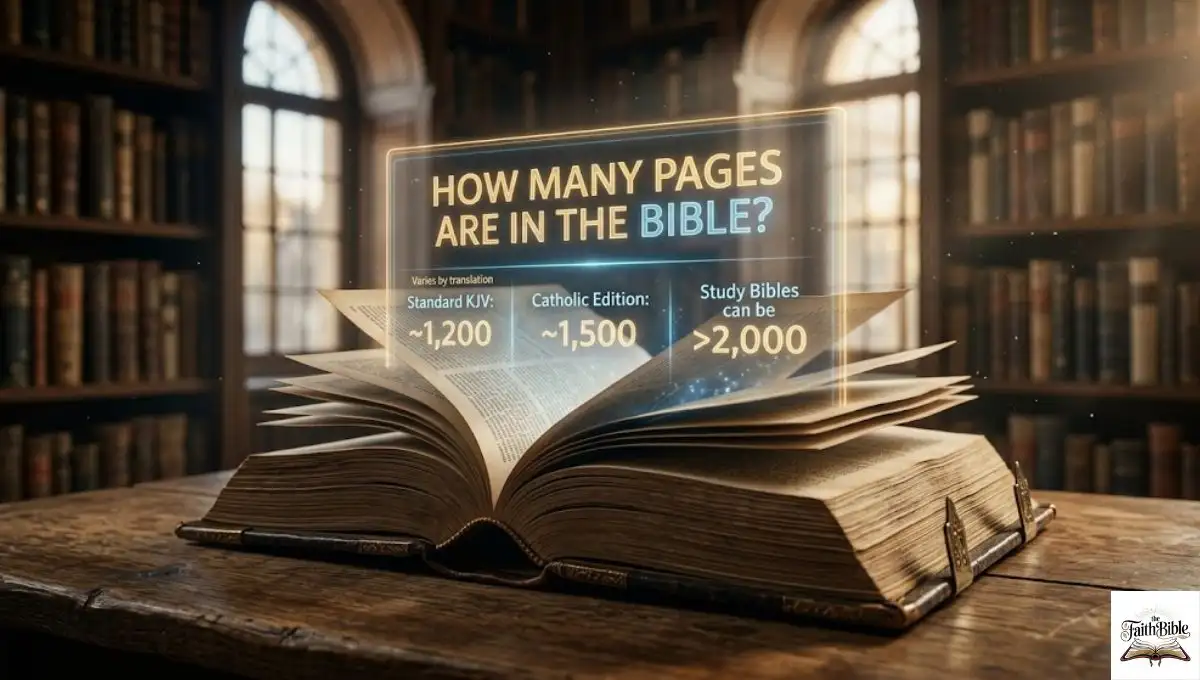
If you’ve ever picked up a Bible and wondered exactly how long it is, you’re not alone. “How many pages are in the Bible?” is one of the most searched questions about Scripture — and the answer is more nuanced than most people expect.
Unlike a standard novel with a fixed page count, the Bible’s length varies significantly depending on the translation, edition, font size, formatting, and whether it includes study notes, maps, or commentary.
In this complete guide, we’ll give you the average Bible page count, explain exactly why different Bibles have different numbers of pages, break down the page counts of 25 of the most popular Bible editions, and answer the most frequently ask questions about Bible length, books, chapters, and verses.
What is the Average Number of Pages in the Bible?
The average number of pages in the Bible falls between 1,000 and 1,500 pages for a standard print edition. However, this range can stretch considerably in either direction depending on the format:
- Compact or pocket Bibles: 800–1,000 pages
- Standard print Bibles: 1,000–1,200 pages
- Large print Bibles: 1,400–2,000+ pages
- Study Bibles with commentary and notes: 2,000–2,800 pages
- Giant print Bibles: 2,000–3,000+ pages
To put this in perspective, the Bible contains 66 books (Protestant canon), 1,189 chapters, approximately 31,100 verses, and roughly 783,000 words in the King James Version — making it one of the longest and most structurally complex books ever compiled.
Old Testament vs. New Testament Page Count
The Bible divides into two major sections with very different lengths:
- The Old Testament contains 39 books (Protestant) and accounts for roughly 75–78% of the Bible’s total length — typically around 750–950 pages in a standard print edition
- The New Testament contains 27 books and makes up approximately 22–25% of the total — typically around 250–350 pages in standard print
This proportion is consistent across most translations, though the exact page count per section will vary based on all the formatting factors discussed below.
Must Read : Caroline Name Meaning: Nicknames & Spiritual Significance
Why Do Bibles Have Different Numbers of Pages?
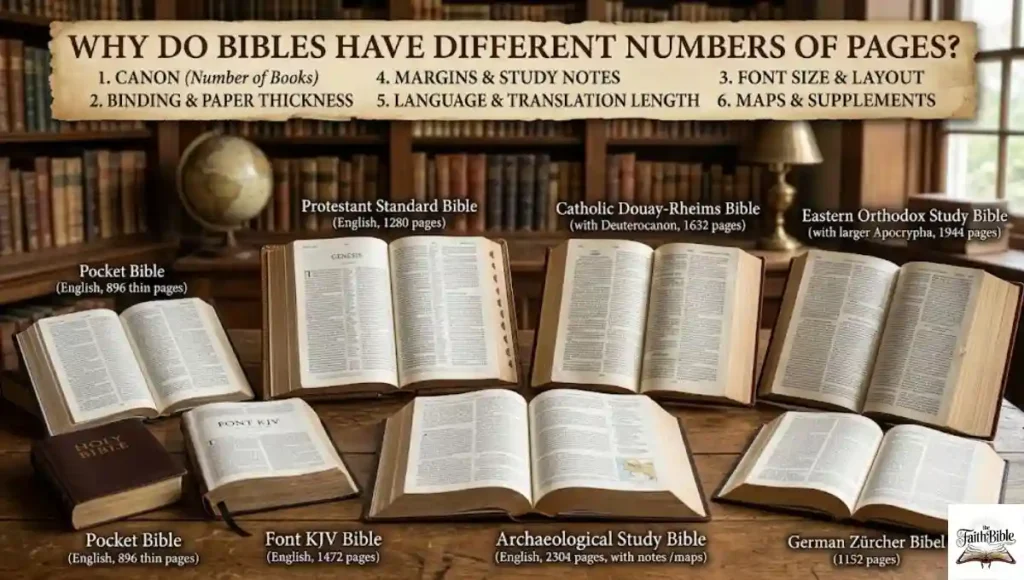
This is one of the most important questions to understand before comparing Bible editions. The content of the Bible — its words, chapters, and books — does not change between Protestant translations. What changes is how that content is presented on the page. Here are the primary reasons why Bibles have different page counts:
1. Translation Differences
Different Bible translations render the original Hebrew and Greek texts with varying word counts. Some translations are word-for-word (formal equivalence), resulting in more compact, dense text; others are thought-for-thought (dynamic equivalence), using more contemporary phrasing that may require more words — and more pages.
- The King James Bible (KJV) uses archaic, often poetic language that tends toward a slightly longer word count
- The New International Version (NIV) aims for clarity in modern English, often using more explanatory phrasing
- The New Living Translation (NLT) is highly readable and conversational, sometimes adding explanatory words not in the original text
2. Font Size and Typography
Font size is perhaps the single biggest variable in Bible page count. A standard print Bible might use 9–10pt font, while a large print edition uses 12–14pt or larger. A giant print Bible designed for elderly readers or those with low vision may use 16–18pt font — nearly doubling the page count of the same translation in standard print.
3. Paper Thickness and Page Layout
Bibles are traditionally printed on thin, high-quality paper — sometimes called “Bible paper” or “India paper” — to keep the physical volume manageable despite the high page count. Some premium editions use thicker paper, which affects the book’s physical thickness but not necessarily its page number count.
4. Column Format
Most Bibles use a two-column layout, which packs more text per page than a single-column format. Single-column Bibles (increasingly popular in reading editions) can add 200–400 pages to the total count compared to the same translation in double-column format.
5. Study Notes, Commentary, and Cross-References
Study Bibles include extensive footnotes, cross-references, maps, concordances, and theological commentary. These additions can nearly double the page count of a standard Bible. A study Bible that would be 1,200 pages in its base text form may run to 2,400–2,800 pages with full study apparatus.
6. Additional Content: Maps, Concordances, and Introductions
Many Bible editions include book introductions, full-color maps, a concordance (an alphabetical index of key words), a topical index, a harmony of the Gospels, or a reading plan. Each of these additions contributes pages beyond the biblical text itself.
7. Protestant vs. Catholic Canon
The Catholic Bible includes 7 additional books known as the Deuterocanonical books (or Apocrypha): Tobit, Judith, 1 Maccabees, 2 Maccabees, Wisdom, Sirach, and Baruch, plus additions to Esther and Daniel. This gives the Catholic Bible 73 books total versus the Protestant 66, adding approximately 100–150 extra pages to the Bible page count.
Factors That Affect the Length and Layout of the Bible
To summarize and expand on the variables above, here are all the key factors that affect Bible length and layout in one place:
Translation: KJV, NIV, ESV, NLT, NKJV, NASB, CSB, and others all render the text slightly differently, affecting word count and therefore page count.
Font size: The most dramatic variable. Standard print vs. large print vs. giant print can double or triple the page count of the same text.
Column layout: Double-column (traditional) vs. single-column (reader’s format) significantly impacts how many pages the text occupies.
Verse formatting: Some Bibles print each verse on its own line (verse-by-verse format), which dramatically increases page count. Others print the text in paragraph form, which is more compact and readable.
Paper quality and thickness: Thin Bible paper is used to reduce physical bulk; thicker paper increases the book’s spine width for the same page count.
Supplementary materials: Maps, concordances, introductions, study notes, timelines, and commentary can add hundreds of pages.
Biblical canon: Protestant (66 books), Catholic (73 books), or Ethiopian Orthodox (81 books) — each has a different total page count.
Binding and margins: Journaling Bibles with wide margins for personal notes can add significant width to each page layout without adding text content.
Number of Pages of 25 of the Top Bibles
Here is a reference guide to the approximate page counts of 25 of the most popular Bible editions. Note that page counts can vary slightly between printings, publishers, and editions of the same translation.
| # | Bible Edition | Translation | Approx. Pages |
| 1 | KJV Standard Bible | King James Version | 1,200–1,300 |
| 2 | NIV Standard Bible | New International Version | 1,100–1,200 |
| 3 | ESV Standard Bible | English Standard Version | 1,100–1,200 |
| 4 | NKJV Standard Bible | New King James Version | 1,200–1,300 |
| 5 | NLT Standard Bible | New Living Translation | 1,200–1,400 |
| 6 | NASB Standard Bible | New American Standard Bible | 1,200–1,300 |
| 7 | CSB Standard Bible | Christian Standard Bible | 1,100–1,200 |
| 8 | NIV Study Bible (Zondervan) | NIV | 2,200–2,400 |
| 9 | ESV Study Bible (Crossway) | ESV | 2,700–2,800 |
| 10 | KJV Study Bible (Thomas Nelson) | KJV | 2,200–2,400 |
| 11 | Life Application Study Bible (NLT) | NLT | 2,200–2,500 |
| 12 | NKJV Study Bible (Thomas Nelson) | NKJV | 2,200–2,400 |
| 13 | KJV Large Print Bible | KJV | 1,600–2,000 |
| 14 | NIV Large Print Bible | NIV | 1,500–1,800 |
| 15 | ESV Large Print Bible | ESV | 1,600–1,900 |
| 16 | KJV Giant Print Bible | KJV | 2,200–3,000 |
| 17 | NIV Giant Print Bible | NIV | 2,000–2,800 |
| 18 | KJV Compact/Pocket Bible | KJV | 800–1,000 |
| 19 | NIV Compact/Pocket Bible | NIV | 800–950 |
| 20 | ESV Compact Bible | ESV | 800–1,000 |
| 21 | Catholic Bible (NAB) | New American Bible | 1,400–1,600 |
| 22 | New Jerusalem Bible (Catholic) | NJB | 1,400–1,700 |
| 23 | The Message Bible | MSG (paraphrase) | 1,400–1,600 |
| 24 | KJV Children’s Bible | KJV | 500–800 |
| 25 | NIV Children’s Bible | NIV | 500–700 |
Note: These are approximate ranges. Exact page counts vary by publisher, print run, edition year, and physical format (hardcover, paperback, leather). Always check the publisher’s specifications for the exact edition you are considering.
Key Takeaways from the Table
- Study Bibles are the longest — the ESV Study Bible at approximately 2,700–2,800 pages is among the most comprehensive single-volume Bibles available
- Pocket/compact Bibles are the shortest — designed for portability, they sacrifice font size and supplementary material to keep the physical size minimal
- The Message (paraphrase) runs longer than many standard translations because its paraphrase style uses more contemporary, explanatory language
- Catholic Bibles are consistently longer than Protestant editions due to the additional Deuterocanonical books
- Children’s Bibles typically contain selected passages rather than the complete text, explaining their significantly lower page count
How Many Books are in the Bible?
Understanding how many books are in the Bible is foundational to understanding its total page count and structure.
Protestant Bible: 66 Books
The standard Protestant Bible contains 66 books, divided as follows:
- Old Testament: 39 books
- New Testament: 27 books
These 66 books were written over approximately 1,500 years by more than 40 different authors — prophets, kings, fishermen, doctors, and scholars — yet maintain a unified theological narrative from creation to redemption. This is itself one of the most compelling arguments for the divine inspiration of Scripture.
Catholic Bible: 73 Books
The Catholic Bible contains 73 books — the same 66 Protestant books plus 7 Deuterocanonical books accepted by the Catholic Church: Tobit, Judith, 1 Maccabees, 2 Maccabees, Wisdom of Solomon, Sirach (Ecclesiasticus), and Baruch. The Catholic Old Testament also includes additional sections in the books of Esther and Daniel.
Eastern Orthodox and Ethiopian Bibles
The Eastern Orthodox Bible includes additional texts beyond the Catholic canon, and the Ethiopian Orthodox Bible — the most expansive biblical canon — contains 81 books, including books not recognized by any other major Christian tradition.
The Biblical Canon
The biblical canon — the officially recognized collection of books accepted as Scripture — was formally established through church councils and the testimony of early Christian communities. The Protestant canon of 66 books was affirmed at the Council of Carthage (397 AD) and later defined more precisely during the Reformation period. The Catholic canon of 73 books was formally defined at the Council of Trent (1546 AD).
How Many Chapters are in the Bible?
The total number of chapters in the Bible is 1,189, broken down as follows:
- Old Testament: 929 chapters
- New Testament: 260 chapters
These chapters were not part of the original biblical manuscripts — they were added by Stephen Langton, Archbishop of Canterbury, around 1227 AD, to make navigation easier. Before this innovation, readers had to know the text itself to find specific passages.
The Longest and Shortest Chapters
- Longest chapter: Psalm 119 — with 176 verses, it is both the longest chapter and the longest psalm in the Bible, dedicated entirely to the glory and importance of God’s Word
- Shortest chapter: Psalm 117 — just 2 verses, yet one of the most powerful declarations of universal praise to God
- Middle chapter of the Bible: Psalm 118 — often cited as the chapter at the numerical center of the Bible
How Many Verses are in the Bible?
The Bible contains approximately 31,102 verses in the Protestant canon:
- Old Testament: approximately 23,145 verses
- New Testament: approximately 7,957 verses
The shortest verse in the Bible is John 11:35 — “Jesus wept” — just two words in the English translation. The longest verse is Esther 8:9, which runs to approximately 90 words in the KJV.
How Many Words are in the Bible?
Word count varies by translation, but commonly cited figures include:
- King James Version (KJV): approximately 783,137 words
- New International Version (NIV): approximately 727,969 words
- English Standard Version (ESV): approximately 757,439 words
- New Living Translation (NLT): approximately 764,240 words
The KJV’s higher word count reflects its more expansive, poetic rendering of the original texts and its archaic phrasings that sometimes require more English words than modern translations.
Frequently Asked Questions
Q: How many pages are in the Bible?
The average standard print Bible contains between 1,000 and 1,500 pages. However, this varies significantly: compact Bibles can have as few as 800 pages, while large print or study Bibles can exceed 2,000–2,800 pages. The content remains the same — it is the formatting, font size, and additional materials that determine page count.
Q: Why are Bible page counts different?
Bible page counts differ because of translation style, font size, column layout (single vs. double column), verse formatting (paragraph vs. verse-per-line), paper thickness, inclusion of study notes, maps, concordances, and commentary, and whether the edition follows the Protestant (66 books) or Catholic (73 books) canon.
Q: How many pages does the KJV Bible have?
A standard print King James Bible typically has approximately 1,200–1,300 pages. A KJV large print edition runs 1,600–2,000 pages, a KJV study Bible runs 2,200–2,400 pages, and a KJV giant print Bible can exceed 2,500–3,000 pages.
Q: How many pages does the NIV Bible have?
A standard print NIV Bible typically contains approximately 1,100–1,200 pages. The NIV Study Bible (Zondervan) runs approximately 2,200–2,400 pages with full study apparatus.
Q: How long is the Old Testament?
In a standard print Bible, the Old Testament typically spans approximately 750–950 pages, representing about 75–78% of the Bible’s total length. It contains 39 books, 929 chapters, and approximately 23,145 verses.
Q: How long is the New Testament?
In a standard print Bible, the New Testament typically runs approximately 250–350 pages. It contains 27 books, 260 chapters, and approximately 7,957 verses.
Q: How many books are in the Bible?
The Protestant Bible contains 66 books — 39 in the Old Testament and 27 in the New Testament. The Catholic Bible contains 73 books, adding 7 Deuterocanonical texts to the Protestant canon.
Q: How many chapters are in the Bible?
The Bible contains 1,189 chapters total — 929 in the Old Testament and 260 in the New Testament. These chapter divisions were introduced around 1227 AD for ease of navigation.
Conclusion
So — how many pages are in the Bible? The honest and complete answer is: it depends. A standard print Bible averages between 1,000 and 1,500 pages. A compact pocket Bible may have as few as 800. A fully equipped study Bible can exceed 2,800 pages.
The Bible page count is shaped by translation, typography, format, canon, and the presence of supplementary materials — but the content, the living Word of God, remains constant across every edition.
What never changes is this: whether your Bible has 900 pages or 2,800, it contains the same 66 books (Protestant), 1,189 chapters, approximately 31,102 verses, and the same eternal, life-transforming truth that has guided believers for thousands of years.
The length of your Bible matters far less than how often you open it. As Psalm 119:105 declares: “Your word is a lamp for my feet, a light on my path.” Whether that Word fits in your pocket or fills a large print study Bible on your nightstand, its power to illuminate, transform, and sustain is unchanged.
“The grass withers and the flowers fall, but the word of our God endures forever.” — Isaiah 40:8

Welcome to Thefaithword! I’m Abdul Mannan Haider. Christian Faith Writer | 10+ Years Bible Study Experience | Founder of (thefaithbible.com)
Sharing prayers and biblical wisdom to strengthen your faith.