
When people search for stay with your own kind Bible verse KJV, they are often trying to understand what the Bible really teaches about relationships, faith, and human connection. Questions like “is stay with your own kind in the Bible” or “what does the Bible say about relationships KJV” reveal a deeper desire for biblical clarity. Many wonder about the biblical meaning of unequally yoked, Christian marriage and faith alignment, and whether Scripture supports separation or unity among people.
In truth, the Bible offers rich wisdom on faith-based relationships, spiritual compatibility, and godly relationships and associations, guiding believers toward unity in Christ rather than division. By exploring key teachings such as Bible verses about relationships and boundaries, biblical guidance on friendships and influence, and the true context behind misunderstood phrases, we can discover what God’s Word really says about love, diversity, and living in alignment with His will.
What Does the Bible Really Mean by “Your Own Kind”?
Let us start with what most people are actually searching for. The phrase “stay with your own kind” does not appear word-for-word anywhere in the King James Version of the Bible. It is not a direct quote. It is a cultural phrase that has been attached to various scriptures — sometimes honestly, sometimes dishonestly.
When the own kind Bible verse KJV question comes up, the passages most commonly cited fall into two categories:
| Category | Common Scriptures Referenced | Actual Biblical Theme |
| Spiritual separation | 2 Corinthians 6:14 KJV | Unequal yoking (faith, not race) |
| Old Testament intermarriage | Deuteronomy 7:3–4 | Idolatry protection, not racial purity |
| Fellowship and community | 1 Corinthians 15:33 KJV | Moral influence of company |
| Marriage guidance | 1 Corinthians 7:39 KJV | Marrying “only in the Lord” |
| Unity in the Church | Galatians 3:28 | All one in Christ Jesus |
Understanding the distinction between these categories is everything. The own kind Bible verse KJV discussion lands differently when you realize the Bible’s concern was always spiritual alignment — never ethnic superiority.
Read More : Tristan Meaning in Hebrew: Biblical Insight, Spiritual Depth
God Created All People in His Image
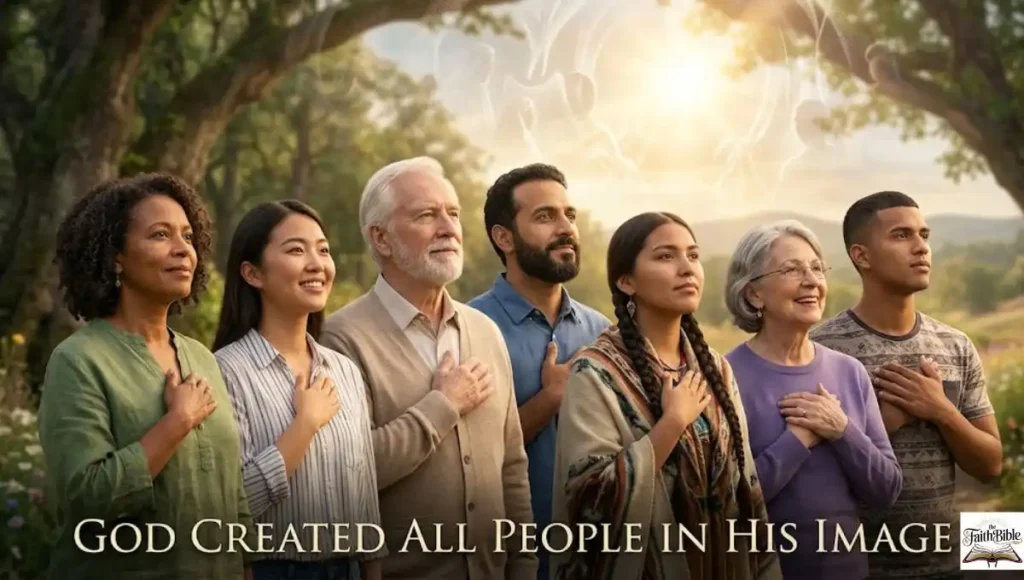
Before any verse about separation, boundaries, or community is considered, this foundational truth must be established clearly:
“So God created man in His own image, in the image of God created He him; male and female created He them.” — Genesis 1:27 (KJV)
Every human being — regardless of nationality, ethnicity, skin tone, or cultural background — bears the image of God. This is called the Imago Dei, and it is the non-negotiable starting point of any Christian conversation about human relationships.
When someone uses the own kind Bible verse KJV to promote racial separation or ethnic superiority, they are building an argument on a foundation the Bible never laid. The very first chapter of Scripture dismantles it.
- Every person you meet carries the image of the Creator.
- God made human diversity — and He called His creation “very good” (Genesis 1:31 KJV).
- No ethnicity is superior, inferior, or more “made in God’s image” than another.
- Racial hierarchy is a human invention. It has no home in the pages of Scripture.
“For God so loved the world.” — John 3:16 (KJV). Not a tribe. Not a nation. The world.
Separation in the Old Testament: Spiritual, Not Racial
The passages in the Old Testament that come closest to the idea of “staying with your own kind” are found in Deuteronomy and Ezra. These are the texts most frequently misused:
“Neither shalt thou make marriages with them; thy daughter thou shalt not give unto his son, nor his daughter shalt thou take unto thy son. For they will turn away thy son from following me, that they may serve other gods.” — Deuteronomy 7:3–4 (KJV)
Read that carefully. God’s stated reason is not skin color or ethnicity. It is idolatry.
The concern was not skin color. It was idolatry.
God was not building a racially pure nation. He was protecting a spiritually faithful one. The surrounding nations worshiped Baal, Molech, Asherah, and dozens of other gods. Marriage into those communities carried an enormous spiritual risk — not because of genetics, but because of gods.
This distinction matters enormously for the own kind Bible verse KJV debate:
- The Israelites were forbidden from marrying idol worshipers — not people of different appearances.
- Rahab, a Canaanite woman who feared God, was welcomed into the community of Israel (Joshua 6:25 KJV).
- Ruth, a Moabite, said “thy God shall be my God” (Ruth 1:16 KJV) and became the great-grandmother of King David.
- Neither Rahab nor Ruth was excluded because of their ethnicity. Their faith was what mattered.
The Old Testament separation laws were about theological purity, not racial purity. These are not the same thing — and centuries of misinterpretation have done enormous damage by treating them as if they were.
The Warning About Unequal Yoking
The New Testament passage most often cited in stay with your own kind Bible verse KJV discussions is 2 Corinthians 6:14:
“Be ye not unequally yoked together with unbelievers: for what fellowship hath righteousness with unrighteousness? and what communion hath light with darkness?” — 2 Corinthians 6:14 (KJV)
This verse speaks powerfully to believers.
It is one of the most important verses in the Bible regarding relationships. But look at what it actually says:
- The division is between righteousness and unrighteousness.
- The division is between light and darkness.
- The division is between believers and unbelievers.
There is no mention of race, nationality, skin color, or ethnicity in this passage. The “yoke” Paul speaks of is a spiritual one. A yoke was a wooden device placed across two animals to make them pull together in the same direction. Paul’s point is clear: if two people are pulling in fundamentally different spiritual directions, the relationship will be strained from the inside out.
This verse is about spiritual compatibility — not racial segregation.
Marriage and Shared Faith
The clearest New Testament teaching on marriage and shared belief is found in 1 Corinthians 7:39 (KJV):
“The wife is bound by the law as long as her husband liveth; but if her husband be dead, she is at liberty to be married to whom she will; only in the Lord.”
The phrase “only in the Lord” is the Bible’s real answer to the own kind Bible verse KJV question as it relates to marriage. It does not say “only within your ethnicity.” It does not say “only within your culture.” It says only in the Lord — meaning, marry someone who shares your faith in Christ.
This is consistent, clear, and entirely about spiritual alignment in relationships, not racial categorization.
- A Black Christian marrying a White Christian is fully within Scripture’s teaching.
- A Latino Christian marrying an Asian Christian honors the Word of God completely.
- A Christian marrying a non-Christian of any background is what the Bible cautions against.
The stay with your own kind Bible verse KJV question, when answered honestly, points to one kind: the household of faith.
Common Misinterpretations of “Stay With Your Own Kind” in Christianity
Over centuries, this phrase has been misused to justify things the Bible never endorsed. Understanding these misinterpretations protects believers from repeating them:
| Misinterpretation | What It Claims | What the Bible Actually Says |
| Racial segregation | God wants races separate | All made in His image (Genesis 1:27) |
| Ethnic superiority | Some races are more favored | God shows no partiality (Acts 10:34) |
| Cultural isolation | Christians must avoid all outside contact | Be salt and light in the world (Matthew 5:13-14) |
| Interracial marriage ban | Cross-cultural marriage is sin | “Only in the Lord” = faith-based, not race-based |
| Tribal favoritism | God prefers one ethnic group | Every nation, tribe, tongue (Revelation 7:9) |
Each of these misinterpretations shares a common flaw: they add words to Scripture that are not there. The own kind Bible verse KJV discussion requires us to read what the Bible says — not what we wish it said.
The Beautiful Diversity of the Body of Christ

One of the most extraordinary passages about the Church appears in Galatians 3:28 (KJV):
“There is neither Jew nor Greek, there is neither bond nor free, there is neither male nor female: for ye are all one in Christ Jesus.”
This is not Paul minimizing real cultural differences. It is Paul declaring that in Christ, those differences do not create hierarchy, separation, or exclusion. The ground at the foot of the cross is perfectly level.
Revelation 7:9 (KJV) gives us a glimpse of heaven itself:
“After this I beheld, and, lo, a great multitude, which no man could number, of all nations, and kindreds, and people, and tongues, stood before the throne, and before the Lamb.”
Heaven is not ethnically segregated. The throne room of God contains every nation, every culture, and every people group standing together in worship. If that is what eternity looks like, it should shape what the Church looks like right now.
The Influence Principle: Choosing Wise Company
Now here is where the stay with your own kind Bible verse KJV question has a genuinely valid biblical application — and it has nothing to do with race.
“Be not deceived: evil communications corrupt good manners.” — 1 Corinthians 15:33 (KJV)
“He that walketh with wise men shall be wise: but a companion of fools shall be destroyed.” — Proverbs 13:20 (KJV)
These verses are about moral and spiritual influence. Who you spend your most intimate time with shapes who you become. This is universally true and biblically grounded.
Your “own kind” in this context means:
- People who share your values and spiritual convictions.
- Friends who challenge you toward righteousness, not away from it.
- A community that holds you accountable to your faith.
- Relationships that build you up spiritually, not wear you down.
This is the legitimate, non-racial application of “staying with your own kind” — choosing people whose character and faith align with where God is calling you.
Biblical Examples of Cross-Cultural Grace
The Bible itself tells the stories of God’s cross-cultural purposes most powerfully. These real examples from Scripture dismantle any racial reading of the own kind Bible verse KJV question:
Moses and Zipporah
Moses, the great deliverer of Israel, married Zipporah — a Midianite woman (Exodus 2:21 KJV). When Miriam and Aaron spoke against Moses because of his Ethiopian wife (Numbers 12:1 KJV), God’s response was immediate judgment — against Miriam, not Moses.
God did not condemn the cross-cultural marriage. He condemned those who opposed it.
Other biblical examples of cross-cultural grace:
- Ruth and Boaz: A Moabite woman becomes part of the Messianic lineage through a marriage that crossed cultural lines.
- Rahab: A Canaanite woman included in the genealogy of Jesus Christ (Matthew 1:5 KJV).
- The Samaritan Woman: Jesus crossed every cultural boundary to offer living water to a woman His culture taught Him to avoid (John 4 KJV).
- Cornelius: A Roman centurion was the first Gentile to receive the Holy Spirit, and God used this moment to expand Peter’s understanding of who belonged in God’s family (Acts 10 KJV).
The pattern of Scripture is consistently expansive, not restrictive. God keeps drawing the circle wider — not narrower.
Guarding Holiness Without Building Walls
There is a real biblical call to guard your holiness. The own kind Bible verse KJV principle, properly understood, asks believers to be intentional about spiritual influence. This is wise and scriptural. But there is a crucial difference between guarding holiness and building walls of division.
- Guarding holiness means choosing close relationships that strengthen your faith.
- Building walls means treating people of other backgrounds as lesser, unwelcome, or spiritually suspect because of their ethnicity.
Jesus modeled the difference perfectly. He was called a friend of sinners (Matthew 11:19 KJV). He ate with tax collectors. He touched lepers. He stopped for Samaritans. He was never spiritually compromised by these interactions — because His holiness was not fragile. It was rooted.
The believer who understands the true own kind Bible verse KJV teaching can engage freely with a diverse world while remaining firmly grounded in who they are in Christ.
Unity in Christ
Practical Life Applications
Here is how the true biblical teaching on this subject applies to real life in 2026:
- In dating and marriage: Choose a partner who shares your faith in Christ. This is the Bible’s actual boundary — not ethnicity, culture, or background.
- In friendship: Surround your inner circle with people whose character sharpens yours. This is about values, not skin color.
- In community: Build relationships across cultural lines. The diversity of the body of Christ is a strength, not a threat.
- In the Church: Welcome every background, culture, and language. Your congregation should look more like Revelation 7:9 than a cultural club.
- In conversation: Correct misuse of the own kind Bible verse KJV teaching gently but clearly. Truth said in love is never wasted.
The True Meaning Behind the Question
People who search for the stay with your own kind Bible verse KJV are usually asking one of three deeper questions:
- Is the Bible racist? No. The Bible consistently affirms the equal dignity of all people made in God’s image.
- Should Christians only date or marry within their faith? Yes — “only in the Lord” is clear, consistent, and grace-filled guidance.
- Does who I spend time with spiritually matter? Absolutely — the influence principle is real, well-documented in Scripture, and has nothing to do with ethnicity.
The question deserves a real answer — not a dismissal and not a distortion. The own kind Bible verse KJV discussion is most productive when it leads people toward a deeper, more honest engagement with what the Bible actually says.
A Compassionate Perspective
If you came to this article holding a belief that God wants people to stay within racial or ethnic lines — this is an invitation to read the Bible more carefully, not an attack on your faith.
The same God who said “be not unequally yoked” also said “love thy neighbor as thyself” (Matthew 22:39 KJV). The same Paul who wrote about spiritual boundaries also declared there is “neither Jew nor Greek” in Christ (Galatians 3:28 KJV). The same Bible that warns about ungodly influence also celebrates Ruth, Rahab, Zipporah, and the Samaritan woman.
The picture is coherent. The Bible calls believers to spiritual discernment in relationships — not racial categorization. And that call is just as relevant, just as serious, and just as life-shaping today as it was two thousand years ago.
FAQ About Stay With Your Own Kind Bible Verse KJV
1. Is “stay with your own kind” an actual Bible verse in the KJV?
No — this exact phrase does not appear in the KJV; it is a cultural expression sometimes linked to scriptures about spiritual fellowship and compatibility.
2. What does the own kind Bible verse KJV most commonly refer to?
It most commonly refers to 2 Corinthians 6:14 KJV, which warns against being unequally yoked with unbelievers — a spiritual boundary, not a racial one.
3. Does the Bible support interracial marriage?
Yes — Scripture never prohibits cross-cultural or interracial marriage; biblical examples like Moses and Zipporah and Boaz and Ruth affirm this clearly.
4. What does “unequally yoked” actually mean in the Bible?
It means a believer entering a deeply committed relationship with someone who does not share their faith in Christ, creating spiritual incompatibility in the relationship’s foundation.
5. Is there a biblical basis for choosing friends based on race?
No — the biblical principle of choosing companions wisely is entirely based on character, faith, and moral influence, never on ethnicity or racial background.
6. What did Jesus teach about people from different cultures?
Jesus consistently crossed cultural barriers — engaging Samaritans, Romans, and Canaanites — modeling that every person has equal worth and equal access to God’s love.
7. How should Christians apply the “stay with your own kind” principle today?
Christians should apply it by seeking spiritually aligned relationships in marriage and close friendship — meaning shared faith in Christ, not shared ethnicity or background.
Conclusion
The stay with your own kind Bible verse KJV question deserves an honest, Scripture-grounded answer — and the Bible provides one that is both clear and beautiful. The own kind Bible verse KJV principle, properly understood, calls believers to seek spiritual compatibility in relationships, guard their faith through wise companionship, and marry “only in the Lord” — a standard built entirely on shared faith, not race, culture, or ethnicity.
The Bible that warns against unequal yoking is the same Bible that fills heaven with every nation, tribe, and tongue worshiping together — and that vision of unity in Christ is the truest expression of what your “own kind” was always meant to be.

Welcome to Thefaithbible! I’m Abdul Mannan Haider. Christian Faith Writer | 10+ Years Bible Study Experience | Founder of (thefaithbible.com)
Sharing prayers and biblical wisdom to strengthen your faith.