
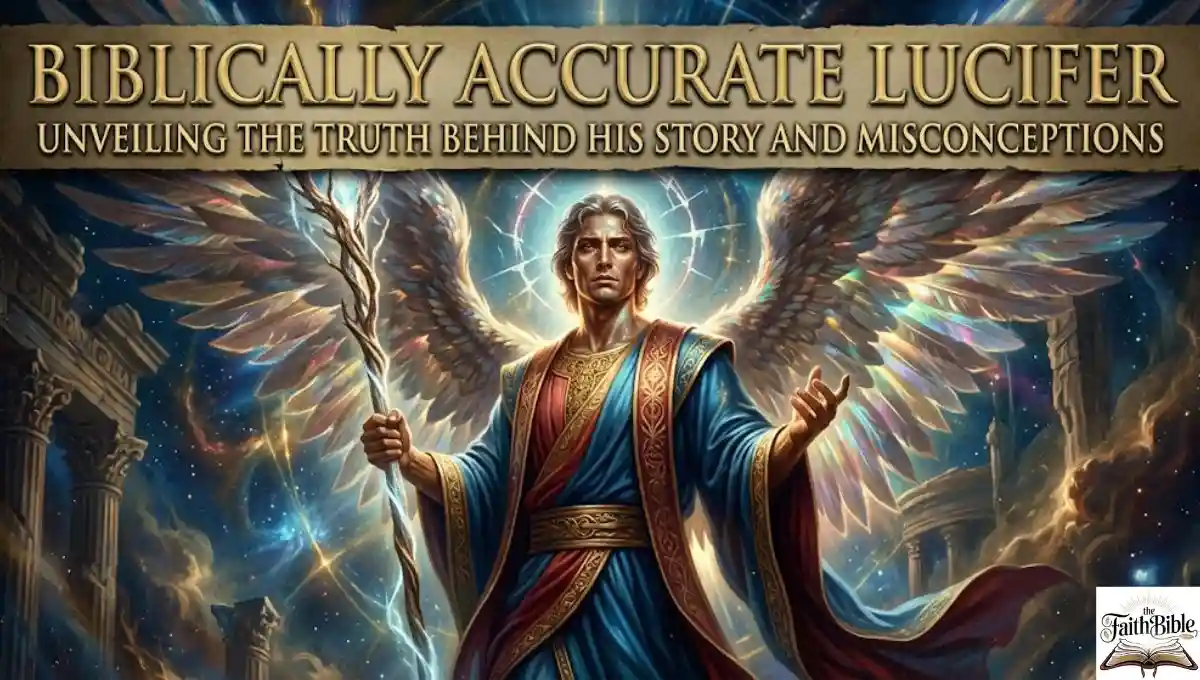
Most people think they know Lucifer, but the biblically accurate Lucifer is far different from popular portrayals in media and literature. Understanding his biblical identity requires exploring Lucifer in Scripture, including the Isaiah prophecy about Lucifer and Ezekiel visions, which reveal his beauty and rebellion as a fallen angel in the Bible.
Many misconceptions arise from mistranslations in the Bible and centuries of spiritual deception and popular misconceptions, obscuring the true story of Lucifer.
When we examine biblical accounts of evil, fallen angel characteristics, and the angelic hierarchy, we uncover a figure whose pride vs purpose and spiritual complexity highlight profound theological significance.
By studying Lucifer in Christian theology and interpreting direct biblical accounts, believers gain insight into his spiritual symbolism, angelic narrative, and the eternal lessons embedded in Scripture, separating scriptural truth from tradition.
Biblically Accurate Understanding of Lucifer’s Identity
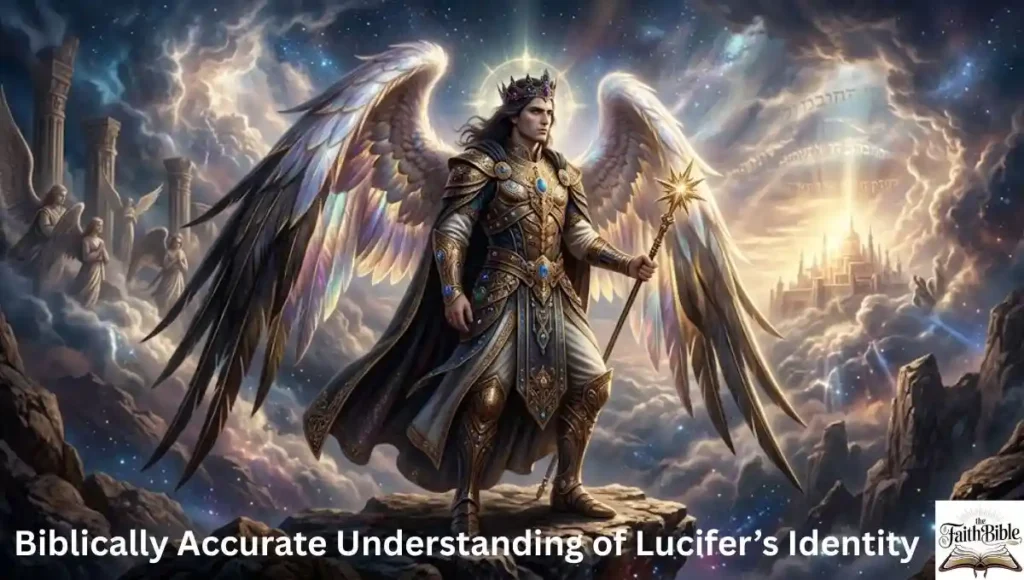
Before diving into specific passages, it is worth acknowledging just how thin the biblical evidence actually is. Most people assume “Lucifer” appears throughout Scripture in Genesis, Revelation, and the Psalms. The reality is far more sobering.
Common Misconceptions About Lucifer in Modern Culture
Pop culture has constructed an entire mythology around Lucifer that bears almost no resemblance to what Scripture describes. Some of the most widespread misconceptions include:
- Lucifer is described as red-skinned with horns and a pitchfork — the Bible contains no such description anywhere.
- Lucifer is mentioned dozens of times throughout Scripture — in truth, the name appears only once in the entire King James Bible.
- Lucifer and Satan are explicitly called the same being in the Bible — Scripture never makes this identification directly.
- Lucifer rules hell as its king — the Bible never portrays him ruling hell; he is cast out and ultimately judged.
- Lucifer’s fall is a major narrative in the Old Testament — it receives only oblique, disputed references in two prophetic passages.
These misconceptions matter because they shape how millions of people understand sin, pride, spiritual warfare, and the nature of evil itself. Getting the biblically accurate Lucifer correct is not merely an exercise in religious scholarship. It has real theological and practical consequences.
What Scripture Actually Reveals About Lucifer
The primary biblical texts connected to Lucifer are Isaiah 14:12-15 and Ezekiel 28:12-17. Together, these passages sketch a figure of extraordinary beauty and wisdom who held the highest position among created angelic beings, enjoyed intimate proximity to God, and ultimately destroyed himself through the sin of pride. Isaiah uses celestial imagery the morning star to describe a catastrophic fall from prominence. Ezekiel uses the language of precious stones, perfect craftsmanship, and a guardian cherub to portray someone who was, in every meaningful sense, the apex of divine creation.
Neither passage provides a systematic biography. Both are embedded in prophetic addresses to earthly kings Babylon and Tyre respectively which has led to centuries of interpretive debate about whether the deeper layer of meaning refers to a supernatural being at all. What they do provide, when taken seriously, is a portrait that shatters almost every popular assumption about who and what Lucifer actually was.
The Hebrew Original: Helel and Its True Meaning
The name “Lucifer” appears exactly once in most English Bibles — Isaiah 14:12 in the King James Version. The original text contains the Hebrew term Helel (הֵילֵל), which comes from the Hebrew root halal meaning “to shine” or “to boast.”
Scholarly research confirms that the word Helel appears only once in the entire Hebrew Bible, making it one of the rarest and most debated terms in all of Scripture. Biblical scholars confirm that Helel ben Shachar translates most accurately as “shining one, son of dawn.” The Hebrew word derives from the root halal, meaning to shine or to radiate. This astronomical imagery pointed directly to the planet Venus as the morning star, which shines brilliantly just before sunrise then disappears as the sun rises.
The Septuagint renders הֵילֵל in Greek as Ἑωσφόρος (Heōsphoros), meaning “bringer of dawn,” the ancient Greek name for the morning star. This is critical context. The original Hebrew author was not writing the name of a specific supernatural being. He was using a poetic astronomical metaphor to describe breathtaking brilliance followed by sudden, total extinction.
Jerome’s Latin Vulgate and the Birth of ‘Lucifer’
Most people are unaware that the word Lucifer was introduced into Christianity through a single translation decision. Around 383 AD, the scholar Jerome translated the Bible into Latin in what became known as the Vulgate. When Jerome reached Isaiah 14:12, he rendered the Hebrew Helel as the Latin word Lucifer, meaning “light bearer” or “morning star.” It was never intended as a proper name.
Notably, Jerome actually used the Latin word Lucifer twice in his translation once for the fallen figure in Isaiah and once for Jesus Christ in 2 Peter 1:19, where the morning star is a title of glory. This remarkable fact alone demonstrates that in Jerome’s own mind, “Lucifer” was simply a descriptive term for radiant celestial brightness not an exclusive name for a demonic being.
King James Translation and English Christian Tradition
The King James Bible was completed in 1611, and it kept the Latin word Lucifer instead of translating the original Hebrew. That one decision shaped English Christian tradition for over 400 years. What started as a Latin description became a permanent name in the English-speaking world. Most modern Bible translations have now corrected it, replacing Lucifer with “Morning Star” or “Day Star.”
The table below summarizes how major Bible translations handle Isaiah 14:12:
| Bible Translation | Rendering of Helel |
| King James Version (1611) | Lucifer |
| New International Version | Morning Star |
| English Standard Version | Day Star |
| New Living Translation | Shining Star |
| New Revised Standard Version | Day Star |
| New American Standard Bible | Star of the morning |
| The Message | Daystar |
| New World Translation | Shining one |
See More : The Authentic Biblical Meaning of the Name MADISON
Biblically Accurate Description of Lucifer’s Appearance
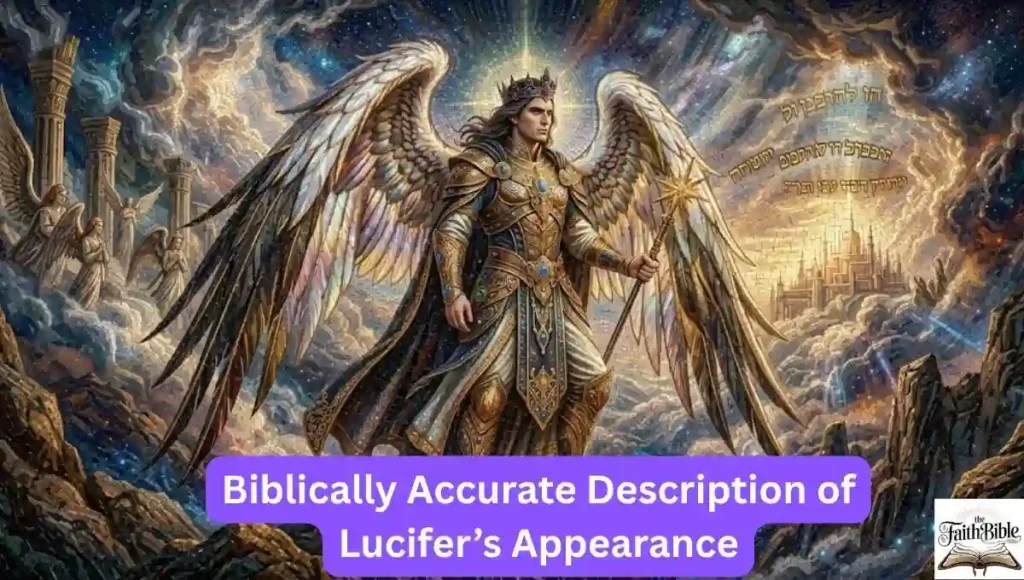
Perhaps the most dramatic gap between popular imagination and biblical reality exists when it comes to Lucifer’s appearance. The Bible does describe him just not in any way that resembles horns, red skin, or a pitchfork.
Lucifer’s Pre-Fall Glory According to Ezekiel
Ezekiel 28:12-15 contains the most detailed physical and positional description of any angelic being in all of Scripture. In Ezekiel, Lucifer is portrayed as the “anointed cherub” and the “seal of perfection,” adorned with every “precious stone” and standing on the “holy mountain.” This imagery, rich in detail, paints him as a beautiful angel one close to God’s presence.
The nine precious stones mentioned sardius, topaz, diamond, beryl, onyx, jasper, sapphire, emerald, and carbuncle were set in gold. Imagine that: multi-faceted brilliance reflecting light infinitely, a walking, dazzling display of divine artistry.
His designation as “anointed guardian cherub” placed him in the highest rank among all heavenly beings those beings specifically tasked with guarding God’s holiness and serving in His immediate presence.
This is the biblically accurate Lucifer before his fall: not a monster, not a demon, but the most magnificent created being in the entire universe.
The Morning Star Imagery in Isaiah’s Prophecy
Venus blazes at magnitude -4.6 — bright enough to cast shadows. Ancient observers noticed its predictable pattern: appearing before sunrise for several months, disappearing, then reappearing as an evening star. This astronomical behavior created perfect metaphorical material. Something that appears to rival the sun itself yet disappears when true light arrives. what better image for pride that exalts itself above God?
Isaiah employs celestial imagery rather than physical description. The morning star metaphor in Isaiah 14:12-15 emphasizes position and trajectory. Venus shines as the last star visible before sunrise, announcing the coming day as herald of dawn. This suggests a role of prominence among created beings.
Does Lucifer Possess Physical Form After His Fall
The Bible is largely silent on this question, and that silence is itself informative. Modern biblical scholars hold that Satan is a spiritual being with no physical form, though artistic renderings of the devil are abundant and vary wildly over the course of history.
After his fall, Scripture never provides a physical description of Lucifer/Satan. He appears as a tempter in Job, an accuser in Zechariah, and a deceiver in the New Testament never as a physically described being.
What Biblical Silence Tells Us Lucifer Is Not
The Bible never describes Lucifer as:
- Having red skin or a red body
- Possessing physical horns or a tail
- Carrying a pitchfork or trident
- Residing as ruler of hell
- Having bat-like wings (this came from medieval art influenced by the pagan god Pan and Dante’s Inferno)
- Being physically grotesque or monstrous in form
The Bible never describes Lucifer as dark or monstrous. It describes a being of breathtaking beauty and radiant light. so perfect in form that his very appearance reflected the glory of God himself.
Symbolism and Meaning Behind Lucifer’s Role in Biblical Texts
Beyond the literal narrative, Lucifer functions as one of Scripture’s most powerful symbols. His story in Isaiah 14 and Ezekiel 28 is not primarily about a named individual but about the universal human and spiritual temptation to place oneself above the Creator.
The morning star imagery symbolizes misplaced glory — just as the morning star briefly outshines everything before the sun renders it invisible, Lucifer’s brilliance existed only in the shadow of God’s greater light.
He represents several layered biblical themes:
- Pride as the root of all sin — his fall is the supreme illustration of Proverbs 16:18 (“Pride goes before destruction”).
- The corruption of gifts — his beauty and wisdom were God-given, and his sin was taking credit for them.
- The danger of proximity to God without humility — he was the closest created being to God, and that proximity became the platform for his rebellion.
- The finite nature of created glory — even the most magnificent created being is entirely dependent on the Creator for existence and purpose.
Common Misinterpretations About Lucifer in Modern Culture
Modern culture has not merely misrepresented the biblically accurate Lucifer — it has fundamentally replaced him with a different character entirely. Here is a direct comparison:
| Cultural Myth | Biblical Reality |
| Red-skinned monster with horns | Being of light, beauty, and wisdom |
| Rules hell as its king | Cast out and awaiting final judgment |
| Name appears throughout the Bible | Name appears once (Isaiah 14:12, KJV) |
| Opposite power to God | A created being, wholly dependent on God |
| Enemy clearly identified from Genesis | Identity and naming are theologically debated |
| Immediately became evil at creation | Created perfect; iniquity was “found” in him later |
| Carries a pitchfork | No physical description after his fall |
The gap between these two columns represents fifteen centuries of artistic invention, theological tradition, and cultural storytelling layered on top of a biblical text that says remarkably little.
Critical Distinction Between Lucifer and Satan in Scripture
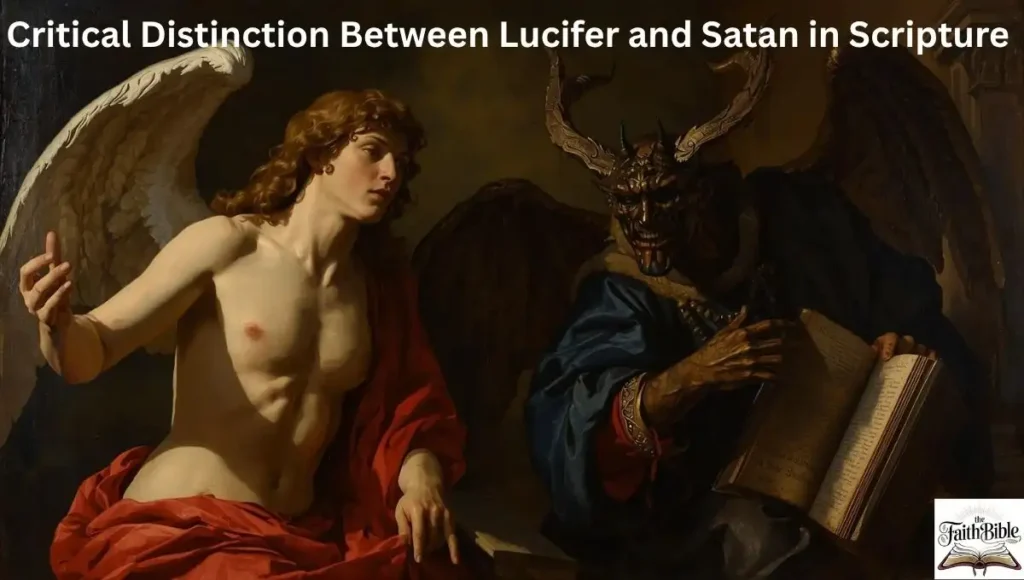
This is perhaps the most theologically significant section of any biblically accurate study. Are “Lucifer” and “Satan” the same being? Popular Christianity says yes, automatically. But the scriptural evidence is far more nuanced.
Biblical Evidence Supporting Their Distinction
“Lucifer” appears exactly once in the King James Bible, translating Hebrew “Helel,” a title describing brightness and glory. Contrast that with “Satan” — this Hebrew word (שָׂטָן) appears 58 times across Scripture, meaning “adversary” or “accuser.” In the Hebrew Bible, “the satan” often appears with the definite article, suggesting a role or office rather than necessarily a personal name. Job 1:6-12 and Zechariah 3:1-2 present “the satan” as a divine council member, testing human faithfulness and serving an accusatory function.
This differs markedly from the prideful cherub described in Ezekiel 28. The contexts, functions, and literary settings of the two figures are genuinely different.
How Christian Tradition Merged These Figures
The metaphor of the morning star that Isaiah 14:12 applied to a king of Babylon gave rise to the general use of the Latin word for “morning star,” capitalized, as the original name of the devil before his fall from grace, linking Isaiah 14:12 with Luke 10 (“I saw Satan fall like lightning from heaven”) and interpreting the passage in Isaiah as an allegory of Satan’s fall from heaven.
The Lucifer-Satan identification developed gradually through interpretation, not explicit biblical statement. Origen of Alexandria (c. 185-254) stands among the first to allegorize Isaiah 14:12. Over subsequent centuries, early Church Fathers wove Isaiah 14, Ezekiel 28, and Revelation 12:7-9 into a unified rebellion narrative that came to feel like established biblical fact even though it was interpretive construction.
Protestant Reformers’ Rejection of the Equation
Contrary to popular assumption, major Protestant Reformers explicitly rejected the Lucifer-Satan equation. John Calvin wrote regarding Isaiah 14:12: “The exposition of this passage, which some have given, as if it referred to Satan, has arisen from ignorance: for the context plainly shows these statements must be understood in reference to the king of the Babylonians.” Martin Luther similarly considered it “a gross error to refer this verse to the Devil.”
These were not fringe positions from minor theologians these were the architects of the Protestant Reformation, and their rejection of the equation deserves serious consideration.
Why This Theological Distinction Matters Today
Understanding the Lucifer vs Satan distinction in Scripture matters for several reasons. First, it protects biblical interpretation from eisegesis reading into the text what is not actually there. Second, it prevents the construction of elaborate cosmological narratives on an extremely thin scriptural foundation.
Third, it forces honest engagement with what the Bible actually says about spiritual warfare, evil, and the adversary. When we conflate two distinct biblical concepts without scriptural warrant, we risk building our theological worldview on tradition rather than truth.
Biblically Accurate Account of Lucifer’s Fall and Significance
The fall narrative itself the biblical account of Lucifer’s fall is one of the most theologically rich and personally applicable stories in all of Scripture.
The Narrative of the Fallen Angel in Scripture
The words “till iniquity was found in you” mark the turning point in his story. His fall is tied to overwhelming arrogance, looking for a throne above God’s creation. As Isaiah 14:13-14 describes, his ambition led to his downfall, symbolized by being “cast out of heaven” to the earth.
The passage does not describe a gradual moral decline. It describes a catastrophic, decisive moment. A single corrupting choice that unraveled the most perfect created being that had ever existed.
Lucifer’s Five ‘I Will’ Declarations of Pride
Isaiah 14:13-14 records five remarkable statements five declarations of self-exalting ambition that constitute the anatomy of Lucifer’s sin. They are:
- “I will ascend to heaven” — claiming the dwelling place of God
- “I will raise my throne above the stars of God” — placing himself over other angelic beings
- “I will sit on the mount of assembly” — claiming God’s ruling position
- “I will ascend above the heights of the clouds” — surpassing all created limits
- “I will make myself like the Most High” — the ultimate declaration: self-deification
Notice that every single statement begins with “I will.” This is not a theology of rebellion it is a theology of self. Every declaration replaces God with self as the center and source of meaning, authority, and existence. In five sentences, Lucifer constructed the entire philosophical framework of pride that has corrupted human hearts ever since.
The Nature of Sin: Pride in God-Given Perfection
According to Ezekiel 28:17, “your heart became proud on account of your beauty, and you corrupted your wisdom because of your splendor.” Pride in his God-given attributes led to his downfall.
This is perhaps the most stunning theological detail in the entire account. Lucifer did not become proud because he was secretly defective or harbored hidden evil.
He became proud because he was genuinely, objectively perfect and then failed to acknowledge that his perfection was entirely a gift from God. The sin was not in possessing beauty and wisdom. The sin was in forgetting that they were received, not inherent.
This makes his story personally urgent for every human being. You do not need to be corrupt to be in danger of pride. You need only to be gifted and to forget the Giver.
Catastrophic Consequences of Angelic Rebellion
The consequences described in Scripture are severe and final:
- Expulsion from the holy mountain of God (Ezekiel 28:16)
- Cast down to earth (Isaiah 14:12)
- Ultimate destruction foretold (Ezekiel 28:18-19)
- Future judgment in the lake of fire (Revelation 20:10)
- From “seal of perfection” to the embodiment of what fallen creation looks like apart from God
The trajectory is from the highest possible position to the lowest possible end morning star to ash.
The Scope of Rebellion: One-Third of Angels
Revelation 12:4 references a dragon whose tail swept a third of the stars (interpreted by many as angels) out of heaven. If this passage is connected to the Lucifer narrative, it suggests that the rebellion had cosmic scope an entire portion of the angelic host was drawn into the catastrophe of one being’s pride.
Milton’s Satan is described as possessing great charisma and the power to manipulate other angels into joining his plots. Whatever the precise interpretation of Revelation 12, the broader biblical picture suggests that Lucifer’s rebellion was not a solitary act but a corrupting influence that swept others along.
Lucifer in Apocryphal and Non-Canonical Texts
Outside the canonical Bible, several apocryphal and pseudepigraphal texts expand the Lucifer narrative considerably. The Book of Enoch (1 Enoch), which is not canonical for most Christian traditions, describes fallen angels called the Watchers who left their heavenly positions. The Life of Adam and Eve, a Jewish apocryphal text, provides one of the earliest explicit accounts of Satan’s pride-driven refusal to honor Adam, which resulted in his expulsion.
The Book of Jubilees similarly elaborates on angelic rebellion. These texts are valuable for understanding how Second Temple Judaism and early Christianity thought about the fall of heavenly beings, but they carry no canonical authority and should not be confused with the biblically accurate account itself. Their narratives are dramatically more elaborate than anything found in Isaiah or Ezekiel, demonstrating how theological imagination consistently outpaces textual evidence when it comes to Lucifer.
Cultural Impact of Lucifer in Literature and Media
The cultural footprint of Lucifer is simply enormous. From Dante’s frozen, three-faced monster in the ninth circle of the Inferno (1320) to Milton’s tragic military commander in Paradise Lost (1667), from Goethe’s cunning Mephistopheles in Faust (1808) to the charming nightclub owner in the Netflix series Lucifer (2016-2021), this figure has served as a canvas upon which every generation projects its own anxieties, fascinations, and philosophical questions.
What these cultural depictions share is a fundamental disconnection from the biblically accurate Lucifer. They are theological commentaries, artistic explorations, and cultural products not biblical portraits. They reveal more about the fears and preoccupations of the societies that created them than about the figure described in Isaiah and Ezekiel. This does not make them worthless; Milton’s Paradise Lost is one of the greatest achievements in English literature. But it does mean they should never be mistaken for Scripture.
Artistic Evolution of Lucifer’s Image Throughout History
The visual history of Lucifer is one of the most fascinating stories in all of Western art a journey from radiant angel to grotesque monster to romantic rebel to theatrical showman, none of which tracks consistently with the biblical text.
Early Medieval Period: The Ethereal Blue Angel
The earliest known suggested depiction of Satan is in a sixth-century mosaic, in the Basilica of Sant’Apollinare Nuovo, Ravenna, Italy. The image shows the devil as an ethereal blue angel, ultimately shed in favor of a more demonic appearance with animalistic traits.
The sixth-century mosaic shows Jesus Christ separating the souls of the saved from the souls of the damned. The blue figure may be Lucifer, the fallen angel later known as Satan. Unlike later depictions, he is beautiful and radiant not the horned, hoofed, red monster of later depictions. This early artistic vision was actually closer to the biblical description than almost anything that came after it.
High Medieval Transformation to Grotesque Forms
In the Middle Ages, artists who wanted to depict Satan were given surprisingly few details from the Bible about how he should appear. “Bits and pieces from lots of now-defunct religions got synthesized: The cloven feet from Pan, the horns from the gods of various cults in the near east. In the 15th and 16th century, these solidified into a horned, bestial, furry figure.”
The Black Death, widespread social upheaval, and intensified focus on hell and judgment influenced artistic representations. Works began portraying him as grotesque, a transitional figure between angel and demon, often with bat-like wings. These depictions found inspiration in narratives like Dante’s Inferno (1320), which described Satan frozen in ice at hell’s lowest point with three faces and bat-like wings.
Renaissance Romanticization: Milton’s Tragic Rebel
Perhaps the devil’s most famous depiction was crafted by English poet John Milton in his 1667 masterpiece, Paradise Lost. The epic poem tells two stories: one of the fall of man and the other the fall of an angel. Once the most beautiful of all angels, Lucifer rebels against God and becomes Satan.
Three hundred and fifty years ago, John Milton gave Lucifer a voice through his poem Paradise Lost. Upon its release, it was regarded instantly as either a work of genius or heretical nonsense. This literary portrayal profoundly influenced subsequent artists. William Blake (1757-1827) illustrated Paradise Lost with images of Satan as a muscular, handsome figure, god-like in physique, suggesting power and beauty even in damnation. Gustave Doré (1832-1883) created dramatic engravings depicting Lucifer with majestic, terrible beauty a fallen prince rather than mere monster.
Victorian Era Through Modern: The Theatrical Red Devil
The 19th century saw the popularization of the theatrical “red devil” image, complete with horns, tail, and pitchfork. This imagery arose from stage productions like Gounod’s opera Faust (1859), where the devil appeared in red costumes for dramatic visibility. This theatrical convention, repeated across countless productions, embedded itself in popular culture.
The image of an unholy creature dressed in red tights originally comes from theater production. The first appearance of the Devil in red tights emerged from Charles Gounod’s opera adaptation of Faust, where the character of the Devil wore a Renaissance-era costume with hose. The image of a Devil in red tights remained popular in the 19th and 20th centuries, often paired with a pointed beard and a pitchfork.
Contrasts Between Artistic and Biblical Portrayals
| Historical Period | Artistic Depiction | Biblical Accuracy |
| Early Medieval (6th century) | Ethereal blue angel, beautiful | Close — reflects pre-fall glory |
| High Medieval (12th-14th c.) | Grotesque monster, bat wings | Distant — drawn from pagan imagery |
| Renaissance (15th-17th c.) | Tragic rebel, beautiful warrior | Partial — captures pride but romanticizes it |
| Victorian/Modern (19th-21st c.) | Red devil, theatrical villain | Very distant — entirely theatrical invention |
Theological Insights from a Biblically Accurate Lucifer
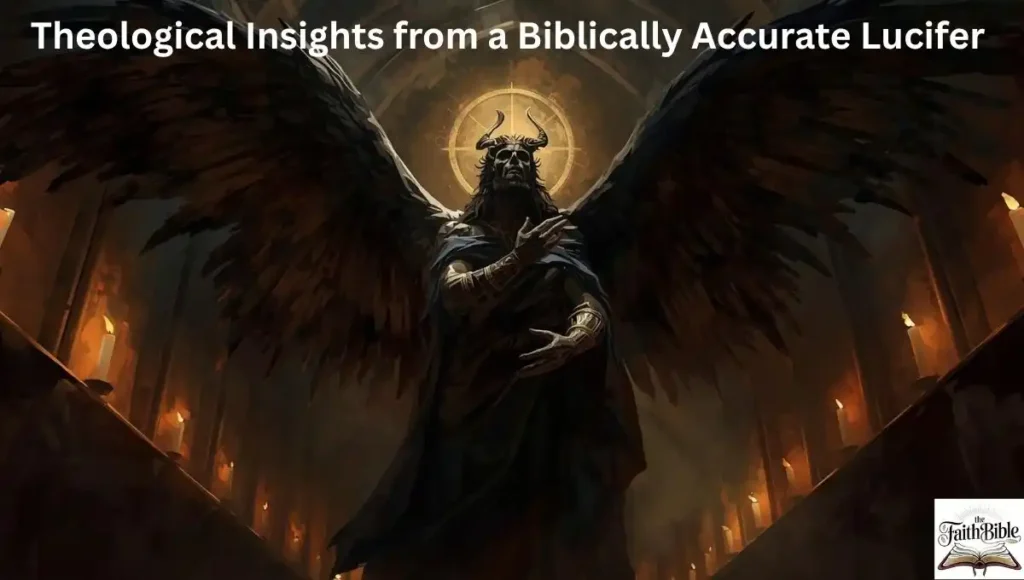
The biblically accurate Lucifer is not merely a subject of historical interest. He is one of Scripture’s most powerful theological teachers a cautionary figure whose story addresses the deepest questions about creation, free will, pride, and dependence on God.
The Paradox of Created Perfection and Free Will
Lucifer’s story raises an immediate and profound question: how did perfect become corrupt? If God created him flawlessly, how did iniquity arise within a flawless creation? The answer Scripture implies is free will. Even a perfect being, given genuine freedom, retains the capacity to choose wrongly. The existence of evil does not require a defect in creation. It requires only freedom and the willingness to misuse it.
The Origin of Evil Within a Perfect Being
Ezekiel 28:17 says, “your heart became proud on account of your beauty, and you corrupted your wisdom because of your splendor.” Pride in God-given attributes led to his downfall. Evil did not enter from outside. It arose from within, through the misattribution of God-given gifts to oneself. This is the biblical anatomy of sin: not external corruption, but internal reorientation turning gifts away from gratitude toward God and toward self-glorification.
Pride’s Specific Temptation: Giftedness and Position
Lucifer’s sin was not random. It was perfectly targeted to his specific circumstances. He was the most beautiful, the most wise, and the most exalted of created beings and his sin was precisely pride in being those things. This is a warning Scripture repeats throughout: the more gifted, the more positioned, the more admired a person is, the more specifically susceptible they are to pride.
Cosmic Implications: Corrupting Others and Spiritual Warfare
The biblical account of Lucifer’s fall does not end with one fallen angel. It spawns spiritual warfare an ongoing cosmic conflict that runs through the entire biblical narrative, from the temptation in Eden to the final battle in Revelation. The Lucifer narrative is the origin story for why that warfare exists. One being’s pride-driven rebellion introduced spiritual conflict into a creation that was designed for harmony.
Lessons for Humanity: Humility and Dependence on God
The Bible’s message is clear choose humility, stay close to God, and never let your gifts become your god. Lucifer possessed everything beauty, wisdom, position, and proximity to God and destroyed it all by forgetting that it was given, not earned. The warning is not directed primarily at the wicked. It is directed at the gifted. At those who have been entrusted with much. At those who, precisely because of their giftedness, face the most acute temptation to credit themselves rather than God.
Frequently Asked Questions
What does the name Lucifer actually mean in Hebrew?
The original Hebrew word is Helel, meaning “shining one” or “morning star,” referring to the planet Venus before sunrise.
Is Lucifer the same as Satan in the Bible?
The Bible never explicitly equates the two; this identification developed through centuries of theological interpretation, not direct scriptural statement.
How many times does Lucifer appear in the Bible?
The name “Lucifer” appears exactly once in the Bible — Isaiah 14:12 in the King James Version.
What did Lucifer look like before his fall?
Scripture describes him as the “seal of perfection,” adorned with nine precious stones, full of wisdom, and perfect in beauty — the most glorious created being.
Why did Lucifer fall from heaven?
He fell because of pride in his God-given beauty and wisdom, declaring through five “I will” statements his desire to exalt himself above God.
Last Words
The story of the biblically accurate Lucifer is one of the most powerful and instructive narratives in all of Scripture, not because it tells us about a monstrous devil, but because it holds up a mirror to something terrifyingly human.
A perfect being, given every gift, chose self-glorification over gratitude and in doing so, became the eternal warning against pride. Stripping away centuries of cultural myth to find the real Lucifer in Scripture reveals that the Bible’s account is far more theologically rich, far more personally confronting, and far more practically relevant than any Hollywood or medieval invention.
The Lucifer Bible verse of Isaiah 14:12, properly understood in its Hebrew and literary context, is not a horror story it is a wisdom text. And its central lesson, that all gifts come from God and must be held with open, humble hands, remains as urgent for every human heart today as it was when Isaiah first wrote it.